

· Steve Callanan · 5 min read
Resistance bands are the cheapest, lightest and most portable kit in any gym, and they get used for very different jobs. A long latex loop that helps you through a pull-up has little in common with a small fabric band that sits above your knees for glute work.
Buying the right ones starts with knowing which type does what. This guide covers the three types you will see most often, power bands, micro or mini bands and knitted fabric bands, and how to choose between them for a home gym.
The three main types of resistance bands
- Power bands are long, flat loops of latex. They anchor to a rig, a bar or your feet and are used for assistance, added resistance on lifts and stretching.
- Micro bands (also called mini bands) are short, thin latex loops that go around the legs. They are mostly used for hip and glute work and warm-ups.
- Knitted fabric bands are short loops like micro bands, but made from elastic fabric with latex woven through it. They do a similar job with a different feel.
Each type comes in graded resistance levels, usually colour-coded, so most people buy them as a pack rather than one at a time.
Power bands: assistance, resistance and stretching
Power bands are the most versatile of the three. Because they are long, they can be looped over a pull-up bar, wrapped around a rack, stood on or attached to a barbell.
Common uses include:
- Assisted pull-ups and dips. Loop the band over the bar and put a knee or foot in it. The band takes some of your body weight at the bottom, where most people struggle.
- Added resistance. Bands attached to a barbell or anchored under your feet add tension that increases as the band stretches, so lifts get harder towards the top.
- Warm-ups and stretching. Pull-aparts, banded shoulder work and assisted stretches all use a lighter power band.
- Movement practice. A band can cue a position, for example pulling the knees out on a squat.
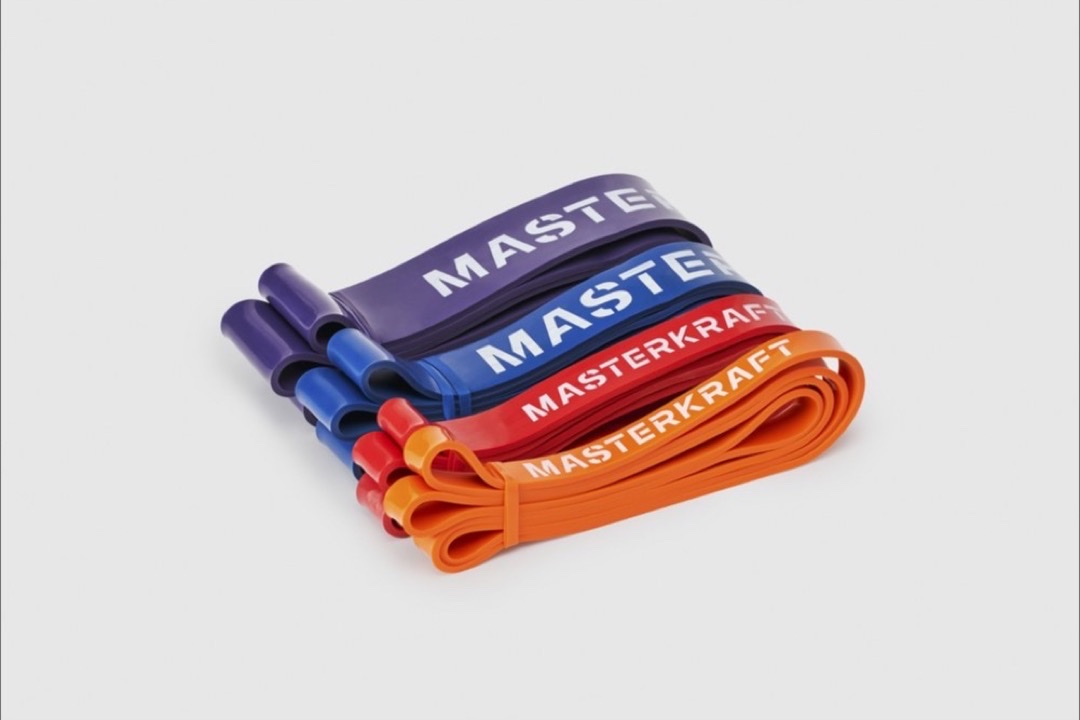
The MasterKraft Power Bands (Pack of 4) are made from 100% latex rubber, 1040mm long and 4.5mm thick. The four bands are different widths (22mm, 32mm, 45mm and 64mm) and each width gives a different resistance level, colour-coded orange, red, blue and purple. There is also an 8-band pack with eight resistance levels for people who want finer steps.
Wider bands are stronger. For pull-up assistance, start with a wider band and move to narrower ones as you get stronger.
Micro bands: glutes, hips and warm-ups
Micro bands are small loops that sit around the thighs, just above the knees, or around the ankles. They add resistance to movements where the legs push outward or sideways, which is why they show up in so many lower body warm-ups.
Typical exercises include lateral band walks, glute bridges, clamshells, banded squats and monster walks.
The MasterKraft Micro Bands (Pack of 4) are 100% latex rubber with four colour-coded resistance levels. Lighter bands suit beginners and movements where your feet are not anchored, such as side raises. Heavier bands suit stronger positions like squats.
The one complaint people have about latex micro bands is that they can roll up or pinch on bare skin, especially on the thighs. That is where fabric bands come in.
Knitted fabric bands: comfort for lower body work
Knitted or fabric bands do the same job as micro bands, with a different construction. The MasterKraft Knitted Resistance Bands (Set of 3) have latex rubber woven into elastic cotton, so the band is wider and grips your legs rather than rolling. They are comfortable on bare skin and can be washed.
Each band in the set is a different thickness and resistance, shown by colour. They suit squats, lunges, leg lifts, bridges and lateral walks, and a lot of people prefer them for longer lower body sessions.
The trade-off is that fabric bands stretch less than latex. They are not a replacement for power bands, and some people use micro bands for light activation and fabric bands for heavier glute work.
Which resistance bands should you buy first?
For most home gyms the decision comes down to what you train:
- If you train with a bar or rack, start with a pack of power bands. They cover assisted pull-ups, warm-ups and added resistance, and they will see the most use.
- If your sessions are mostly lower body or body weight, start with a set of knitted bands or micro bands.
- If you do both, buy one pack of each. They are inexpensive and they do not overlap much.
Whichever you choose, check bands for nicks or splits before each session and replace any that are damaged. Latex is a wear item.
Store bands so they last
Bands left on the floor get stepped on, tangled and damaged by grit. Hang them up instead. A small wall rack such as the Rope & Band Rack (Wall Mounted) (Small) has eight pegs, which is enough for a full set of power bands and a few smaller loops. Keep latex out of direct sunlight, which degrades it over time.
If you are still planning the room, our guide to setting up a home gym covers wall storage and layout.
Find the right bands
You can compare every pack in the resistance and power bands range, with stock on each product page. For a studio or PT space, our fit-out team can plan bands and wall storage as part of the room.