

· Steve Callanan · 6 min read
Buying a dumbbell set in one go is a different job from picking up a pair at a time. You are not choosing a weight, you are choosing a range: where it starts, where it stops, how big the steps are in between and where it all lives once it arrives.
Get those four things right and the set covers almost every program you will run at home. Get them wrong and you end up with a full rack that still has gaps where you need them most. This guide works through what a complete set should include and how to buy one.
What a complete dumbbell set should span
Think of a set as a ladder. The bottom rung is your lightest pair, the top rung your heaviest, and the rungs in between are the increments.
- The lightest pair is for shoulder and arm work: lateral raises, rear delt flyes, rotator work and the like. For most adults, 1kg to 3kg covers this.
- The heaviest pair is for lower body and pulling work: goblet squats, split squats, Romanian deadlifts, rows and carries. This is where people undershoot. A set that tops out too low gets outgrown on the lower body first.
- The middle of the range is where most sessions happen. Presses, rows and most accessory work sit here, so this is where you want the smallest steps.
A household with more than one person training should size the set for the strongest lifter at the top and the newest lifter at the bottom. It is cheaper to buy the range once than to add a second set later.
Increments: why the steps matter more than the total
The gap between pairs decides whether you can progress smoothly. At the light end, a 1kg jump is a big change in percentage terms, so 1kg steps make sense. Once the pairs get heavier, 2.5kg steps are the norm and still feel manageable.
The MasterKraft rubber hex dumbbell range shows the usual pattern. It runs in 1kg steps up to 10kg (with 2.5kg and 7.5kg pairs as well), then in 2.5kg steps from 10kg up to 45kg. A set built from that range can be as fine or as coarse as you like in the middle.
When you compare sets, look past the total weight on the box. Two sets with the same total can have very different coverage. One might be ten light pairs, the other five pairs with large gaps. The list of pairs tells you far more than the headline number.
How many pairs is a complete set?
There is no single answer, but most complete home sets land somewhere between ten and fifteen pairs. Fewer than that and the gaps start to show. More than that and you are usually adding heavy pairs that only one person uses, or doubling up on increments that are too close to matter.
A useful check: lay out the exercises you do every week and write the weight you use for each. If every exercise has a pair within one step of it, the set is complete for now. If several exercises fall between two pairs, the set needs a pair in that gap before it needs a heavier pair at the top.
Set packages vs picking your own pairs
There are two ways to buy a complete set.
A set package gives you a fixed list of pairs, usually with a rack, in one order. The increments are complete from the first day and the rack is already sized to the set. MasterKraft sells two:
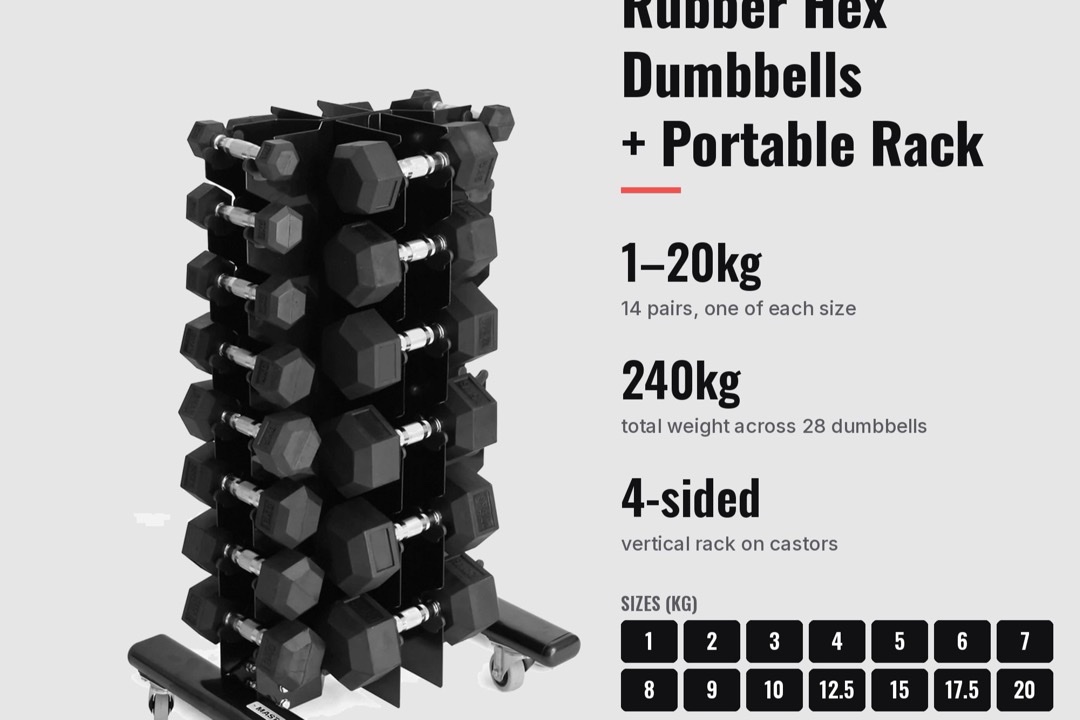
- The Rubber Hex Dumbbell Set of 14 Pairs: every kilogram from 1kg to 10kg, then 12.5, 15, 17.5 and 20kg. That is 28 dumbbells and 240kg in total, on a portable four-sided vertical rack that rolls on castors.
- The Chrome 110 set: ten pairs of hardened chrome dumbbells from 1kg to 10kg in 1kg steps, 110kg in total, sold with or without a vertical rack. It suits light work and smaller rooms.
Picking your own pairs makes sense when a package stops short of where you need it, or when you want a different spread. A common approach is to start from a package and add heavier pairs above it from the same range, so the whole set still matches.
Match the rack to the set
The rack is part of the set, not an extra. Buy it at the same time and size it for the set you plan to own, not just the pairs in the first order.
- Vertical racks hold a run of pairs on a small footprint, which suits spare rooms and garages. The MasterKraft vertical dumbbell racks come in 10 pair and 15 pair versions, single or double sided, plus a portable four-sided version.
- Horizontal racks hold pairs on two or three tiers at an easy height to grab and return. They take more wall length but suit sets with heavier pairs, which are easier to lift off a low tier than a tall stand.
Check the rack suits the head shape of your dumbbells. Some racks are designed for round heads and others for hex, and the product page will say which. Also check the published dimensions against your room before you order.
Stick to one finish and style
A complete set looks and works best when every pair comes from the same range. One finish means every handle feels the same, the weights read the same way and the set sits neatly on one rack. Mixing ranges often means different head sizes, which can make pairs sit unevenly in the saddles.
If you are still choosing a finish, our guide to rubber hex, chrome and urethane dumbbells compares them. If you are weighing a fixed set against an adjustable pair, start with fixed vs adjustable dumbbells.
Find the set that fits your room
You can compare every pair, package and finish in the dumbbells range, with stock and lead times on each product page. For a larger home gym or a studio, our fit-out team can plan the set, the rack and the flooring together.