

· Steve Callanan · 4 min read
It is the first big decision in most home gyms, and the internet gives you two loud answers. Adjustable dumbbells promise a whole rack in two handles. Fixed dumbbells promise to never break. Both are partly right.
This guide compares them on the things that matter in a real room, then helps you choose the weights to start with.
How each type works
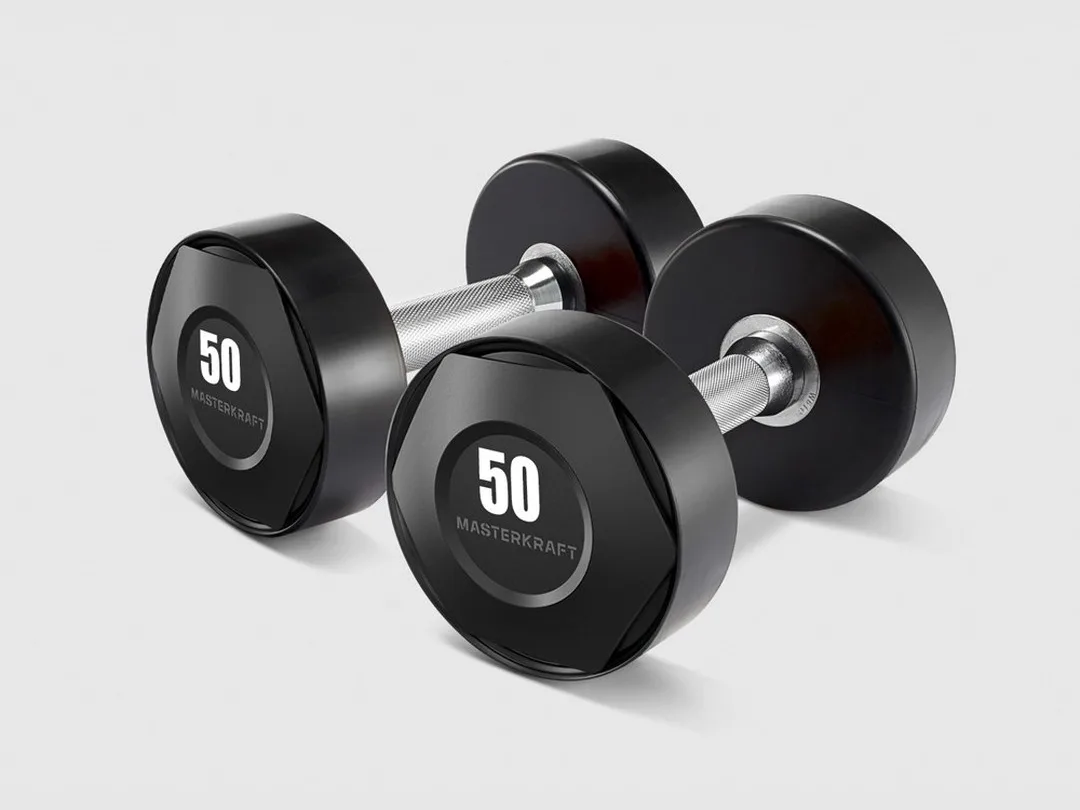
Fixed dumbbells are one weight each, permanently. Rubber hex, round rubber, urethane and chrome are the common finishes. You pick up a pair and train.
Adjustable dumbbells use a handle and removable plates. Some use a selector dial or pin, so you change the weight without touching the plates. Older spin-lock designs use a collar that screws on and off.
Space: adjustable wins, but by less than you think
This is the case for adjustables, and it is a real one. A single pair can replace a long run of fixed pairs, and it sits in a small stand.
The gap narrows once you add storage. A vertical rack holds a run of fixed pairs on a footprint not much bigger than an adjustable stand. If you have a spare wall or a corner, fixed dumbbells fit more rooms than people expect.
Speed between sets: fixed wins
With fixed dumbbells, changing weight means putting one pair down and picking up another. Supersets, drop sets and circuits flow. Training with a partner works, because you are not sharing a single pair.
With adjustables, every weight change is a stop. Dial designs are quick, but you still put the handle back in its cradle each time. Spin-lock collars are slow enough that most people stop changing the weight mid-session.
Durability: fixed wins clearly
A fixed dumbbell is a solid object. There is nothing to adjust, so there is nothing to wear out of adjustment. It survives being set down hard, which happens in every home gym eventually.
A selector mechanism is a set of moving parts, and dropping an adjustable dumbbell is the one thing every manufacturer tells you not to do. If the mechanism fails, the whole weight range comes off the floor at once, not just one pair.
Cost: it depends on how far you go
Adjustables usually cost less for a full range bought on day one. Fixed dumbbells cost more in total, but you can buy them a pair at a time, starting with the weights you use most and adding heavier pairs as you get stronger. Plenty of home gyms never need the extremes of the range at all.
Fixed dumbbells also hold their value. A good rubber or urethane pair is still a good pair in ten years.
Which suits your room
Choose adjustable if floor space is the binding constraint, you train alone, and your sessions are straight sets rather than fast circuits.
Choose fixed if you want the weights to last, you train with a partner or move quickly between exercises, or you are building a room you plan to keep adding to. Fixed is also the only sensible choice if the dumbbells will be dropped.
MasterKraft makes fixed dumbbells only, for the reasons above. They are the same dumbbells that go into commercial floors, where they get used all day.
Choosing your starting weights
Do not buy a full rack on day one. Buy the pairs you will use every week, then fill in.
- Start with three or four pairs that cover your lighter accessory work, your main pressing and rowing weight, and something heavier for lower-body work and carries.
- Fill the gaps in the middle first. The middle of the range does most of the work in most programs, so that is where the next pairs earn their place.
- Add heavy pairs when you need them, not before. Heavier dumbbells are where the money goes, so let your training decide when you buy them.
MasterKraft's virgin rubber fixed dumbbells come in 21 sizes from 10kg to 60kg, each priced individually on the product page, so you can build the set one pair at a time. For lighter work, chrome dumbbells cover 1kg to 10kg.
Plan the storage with the set
Whatever you buy, give it somewhere to live. A dumbbell rack keeps pairs together, off the floor and at a height you can lift from safely. Size it for the set you plan to own, not just the first few pairs. Our home gym setup guide covers storage, flooring and layout in more detail.
Every dumbbell size and every rack is priced on the site, so you can build your set tonight.