

· Steve Callanan · 6 min read
A squat rack is the piece of equipment a strength-focused gym is built around. It holds the bar at the right height to get under it, catches the bar when a rep fails, and gives you somewhere to bench, press and pull from. Get it right and the rest of the room falls into place around it.
The choice usually comes down to three shapes: a full power rack, a half rack, or a rack fixed to the wall. This guide covers what each does, how much room each needs, and the attachments that change what a squat rack can do.
What a squat rack has to do
Whatever the shape, a squat rack has three jobs:
- Hold the bar at a height you can step under, using J-hooks that adjust up and down the uprights.
- Catch the bar if you cannot finish a rep, using safety bars or spotter arms set just below the bottom of your range.
- Stay put, so the frame does not walk, rock or flex when a loaded bar comes down on it.
Everything else, from pull-up bars to plate storage and cable pulleys, is useful but secondary. Judge a rack on those three first.
Power rack: the full cage
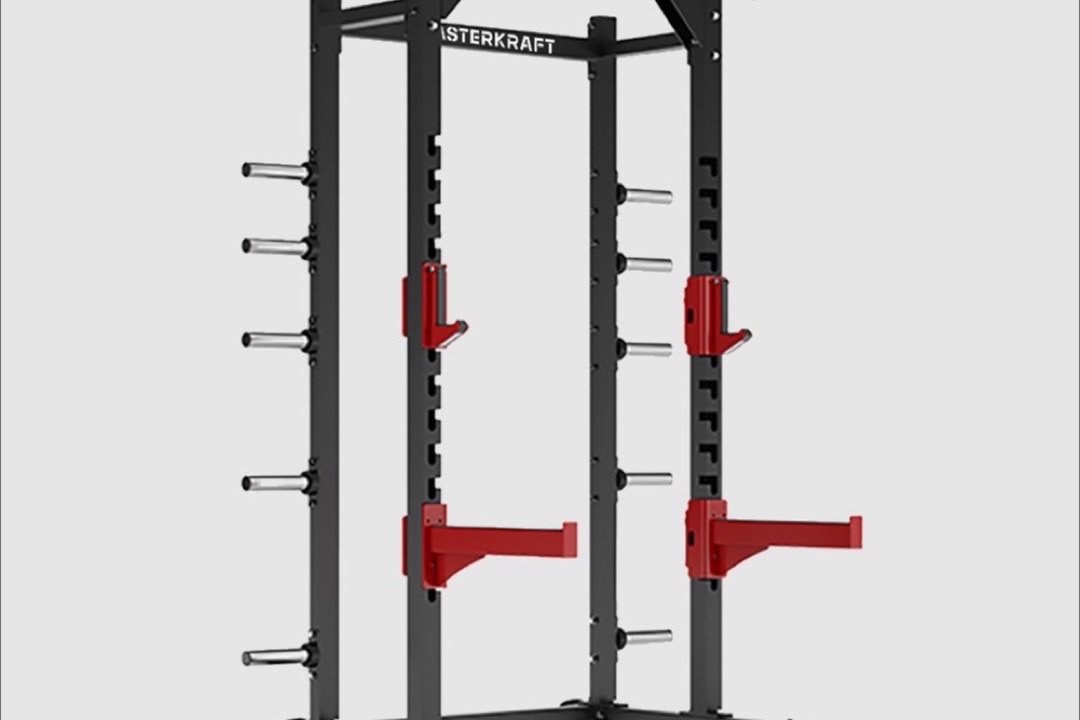
A power rack has four uprights joined into a cage. You train inside it, with safeties on both sides, so a failed squat or bench press lands on steel rather than on you. That is the reason to choose a cage: it lets you work to your limit without a spotter, which is exactly the situation most home lifters are in.
The cost is floor space. MasterKraft's power racks give a sense of the range:
| Rack | Assembled size (L × W × H) |
|---|---|
| Olympic Power Rack 1.0 | 1,652 × 1,311 × 2,125mm |
| Olympic Power Rack 2.0 | 2,035 × 1,160 × 2,275mm |
| Olympic Power Rack 3.0 | 1,735 × 1,465 × 2,442mm |
| Olympic Power Rack 4.0 | 2,047 × 1,735 × 2,442mm |
The 1.0 is the entry-level commercial rack, in 11 gauge (2.75mm) steel with adjustable J-hooks, safety spotter arms and a dip attachment. The Olympic Power Rack 3.0 has a compact footprint and covers squats, bench presses and pull-ups. The 5.0 is a full four-post cage built for heavy squatting, pressing and pulling on a commercial floor.
Remember that a rack's footprint is not its working space. You need room to load plates on both ends of the bar and to walk in and out.
Half rack: most of the function, less floor
A half rack uses two main uprights rather than a four-post cage. You still get adjustable J-hooks and safeties, but you train in front of the rack rather than inside it, and it takes roughly half the floor of a power rack.
For most rooms, that trade is worth making. A half rack handles squats, presses and rack pulls well, and it is easier to fit into a garage or small studio. The case for a full cage over a half rack is mainly for lifters who regularly train to failure on heavy squats without anyone watching.
MasterKraft's half racks include a freestanding Half Rack 2.0 and a Half Rack with Dead Lift, which integrates a deadlift platform so squatting, pressing and pulling all happen in one footprint.
Wall-mounted racks: the floor stays clear
A wall-mounted half rack is fixed to the wall instead of standing on a base. You keep the squatting and pressing, and the floor in front of it stays clear when you are not using it. That makes it the option for narrow rooms and spaces that have to do other jobs, such as a garage that still needs to fit a car.
The catch is the wall. It has to take the load, and the fixings matter. With the Olympic Half Rack (Wall Mounted), we ask that you talk to us about the wall and fixings before it is specified.
Squat stands: the minimal option
Squat stands are two separate uprights with hooks, and sometimes short safeties. They take the least floor and are the easiest to move, but they are also the least stable and offer the least protection when a rep fails. They suit lighter training and rooms where a rack simply will not fit. If you plan to squat or bench heavy on your own, a half rack or power rack is the safer home for the bar.
Measure the ceiling before anything else
Ceiling height catches out more home buyers than floor space does. Look at the heights in the table above: from 2,125mm for the Power Rack 1.0 to 2,442mm for the 3.0 and 4.0. Garage ceilings, roller-door tracks and downlights can all sit lower than that.
When you measure, check three things:
- The rack's own height, plus clearance to stand it up during assembly.
- Overhead pressing, since the bar travels above your head while you stand on the floor or on rubber flooring.
- Pull-ups, if the rack has a chin-up bar. You need space for your head above the bar, not just the bar itself.
If the ceiling is tight, a lower rack or a half rack set in front of the lowest point of the roof often solves it.
Attachments that change what a squat rack does
A rack becomes far more useful with the right attachments:
- Dual pulleys. The Olympic Half Rack with Dual Pulley builds a cable system into the uprights, so pulls, presses, rotations and accessory work happen at the same station as your barbell training. There is also a wall-mounted version and a power rack with dual pulleys.
- Plate storage. Storage on the rack keeps plates where the bar is, and the Power Rack 2.0 has a matching weight plate storage rack.
- Dip attachments and landmines, which add movements without adding a separate machine.
Choosing your squat rack
- Choose a power rack if you train heavy on your own and have the floor and ceiling for a cage.
- Choose a half rack if space is tight or you train with a partner, and you want most of the function in half the floor.
- Choose a wall-mounted half rack if the floor has to stay clear and you have a wall that will take the load.
- Add dual pulleys if the rack has to be your whole gym.
Then pick the bar to go in it. Our guide to choosing a barbell covers weights, knurling and sleeves. Browse the full squat and power racks range, or, for a studio or larger room, our fit-out team can plan the rack layout with you.