

· Steve Callanan · 5 min read
Few pieces of gym equipment start as many arguments as the Smith machine. Some lifters say it has no place in a serious gym. Others use one every week and would not train without it. As usual, the useful answer sits between the two, and it depends on who is training and how.
This guide covers what a Smith machine does well, where a free-weight rack does the job better, and how to decide whether one belongs in your home gym or studio.
What a Smith machine is
A Smith machine is a barbell fixed to a guided track. The bar runs up and down on the track and cannot travel out of its plane, so it cannot drift forward, back or to the side. On most Smith machines, hooks on the bar let you lock it onto the frame at almost any point in the movement, usually with a twist of the wrists.
That single feature, the fixed path, is the source of both its strengths and its limits.
What a Smith machine does well
Training alone, close to failure. Because the bar can be locked out at any point, a lifter can push a set close to failure without a spotter. That is why the Smith machine is often the station members use when training on their own.
Constraining a movement. A fixed path takes balance out of the lift. Coaches use that when a client needs a simpler version of a movement while they build confidence, or when the goal is to load one muscle group without the lift being limited by stability.
Accessory volume. Split squats, calf raises, inclined presses, hip thrusts and rows can all be loaded on a Smith machine and set up quickly, which suits high-volume accessory work.
Getting started with barbell training. For newer lifters, the guided bar can be a less intimidating first step into loaded squatting and pressing.
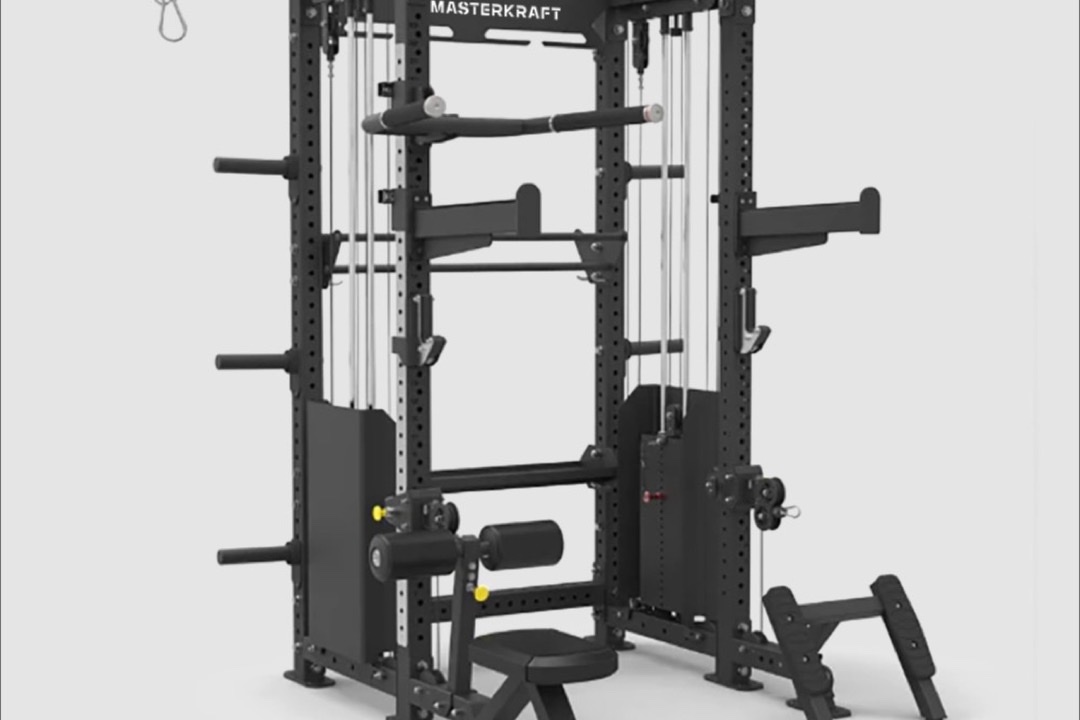
MasterKraft's Smith machine is built around exactly these uses: a guided barbell path for solo training, working near failure without a spotter, and accessory volume.
What a Smith machine does not do
The fixed path also takes things away:
- Stabilising muscles do less work. With balance handled by the track, the small muscles that steady a free bar get less training.
- The path is the machine's, not yours. A free bar finds its own line. A Smith bar follows the track, which some lifters find suits their mechanics and others do not.
- Some lifts are off the table. Cleans, snatches and other dynamic barbell lifts need a free bar.
- Numbers do not transfer directly. A weight you lift on a Smith machine is not the same as the same weight on a free bar, so track them separately.
None of this makes the Smith machine a bad choice. It makes it a different tool.
Smith machine vs free-weight rack
If you can only have one, the comparison usually looks like this:
| Smith machine | Free-weight rack | |
|---|---|---|
| Training alone near failure | Strong, lock out anywhere | Relies on safety bars set correctly |
| Exercise range | Guided presses, squats, accessories | Everything a barbell can do, plus pull-ups and attachments |
| Stabiliser work | Less | More |
| Learning curve | Lower | Higher |
| Olympic lifts | No | Yes, with the right bar and floor |
For most home gyms, a rack is the better first purchase. It does more, and with safety bars set correctly, it protects a solo lifter well. Our squat rack guide covers choosing between power racks, half racks and wall-mounted racks.
When a Smith machine makes sense in a home gym
A Smith machine earns a place at home when:
- You train alone and want to work close to failure on presses and squats with the least setup.
- You prefer a guided movement, or you are new to loaded barbell training.
- You already have a rack and want a second barbell station for accessory work.
If none of those apply, the money and floor space usually go further on a rack, a bench and a good set of dumbbells.
When a Smith machine makes sense in a studio or PT gym
In a studio, the case is stronger. A Smith machine gives members who train alone a safe barbell option, and gives coaches a way to load a movement while taking balance out of it. It also takes pressure off the racks at busy times, because accessory work can move to the Smith machine.
A common studio layout pairs a Smith machine with one or two racks. Where space is tight, a rack with cables built in, such as the Olympic Half Rack with Dual Pulley, can cover more movements in one footprint, with the Smith machine added as the floor grows.
What to check before you buy
Smith machines vary more than their shared name suggests. Before you buy, check:
- Footprint and height. Check the assembled dimensions against your floor and ceiling, with room to load plates on both sides.
- Starting bar weight. Smith bars do not all weigh the same as a standard barbell, and some are counterbalanced. Ask what the bar weighs so you can track your loads.
- Safety stops. Look for adjustable stops that can be set just below the bottom of your range.
- Load rating. Check the published maximum load before you plan your heaviest sessions.
- Plate storage. Storage on the frame keeps plates where you need them.
If any of these are not on the product page, ask us before you order.
Choosing the right barbell station
A Smith machine is worth it when the people using it train alone, want a guided bar, or need a second barbell station. Otherwise, start with a rack. Browse the squat and power racks range, or, if you are planning a studio or PT gym, our fit-out team can work out the right mix of Smith machine, racks and benches for your floor.