

· Steve Callanan · 6 min read
A leg press machine lets you load the legs heavily with the back supported and no bar on your shoulders. That is why it earns a place in so many gyms: beginners can train a big leg pattern safely, and experienced lifters can push volume well past the point where a squat would stop them.
It is also one of the largest machines you can put in a room. Before buying, it pays to understand the main designs, how they load, and how much space they really take once plates and people are around them. This guide covers all three, for home gyms, small studios and PT gyms.
Why buy a leg press machine at all?
If you already own a rack and barbell, a leg press can feel like a luxury. In practice it does a different job.
- No balance demand. The machine controls the path, so the legs can work hard without the trunk or balance becoming the limit.
- No spinal loading. The load goes through the sled and footplate, not down through the back.
- Easy to coach. For a PT, a leg press is a fast way to give a new client meaningful leg work in the first session.
- Volume after the heavy work. Many lifters squat first, then use the leg press to add more leg work once the bar work is done.
None of this replaces squatting. It complements it, and for some trainees it is the main way they load the legs.
The 45 degree leg press
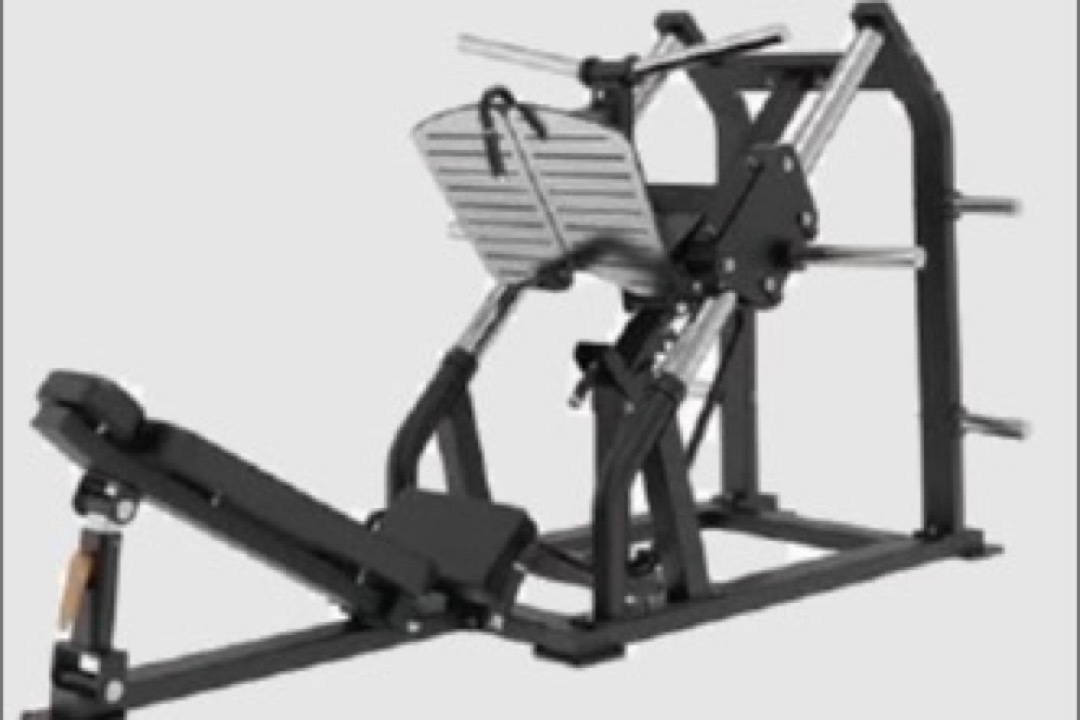
The 45 degree design is the classic. You sit in a reclined seat, place your feet on a sled that travels up and down a fixed linear path at 45 degrees, and press. The angle is what makes it work: it lets you move a heavy load through a long range with the back supported the whole way.
MasterKraft's Linear Leg Press 45 Degrees is this design: a 45 degree linear path and a fully supported back position. It is built for the heaviest leg loading on the floor, which also means you need to plan for the weight plates that go with it.
What to check on any 45 degree leg press:
- The sled and rails. The sled should travel smoothly with no side play. Rough or sticky travel gets worse under load.
- Safety stops. Look for stops or catches you can set so the sled cannot come down further than you want. Check how easy they are to reach from the seat.
- Footplate size. A large footplate allows high, low, wide and narrow foot positions, which changes how the movement feels for different lifters.
- Seat and back pad. Check adjustment and comfort, because the lifter spends the whole set pressed into them.
- Published load rating. Check the rating on the product page or ask for it, and make sure it suits the heaviest loads you expect to use.
Leg press and hack squat combo
A hack squat is a guided squat with the back braced against a pad. It loads the quads heavily on a fixed path, and many lifters and coaches want both it and a leg press in the program.
The problem is space. Both machines are large, and fitting two of them into a home gym or a small studio is often not realistic. A combination machine solves that by putting both patterns on one frame.
The MasterKraft Leg Press & Hack Squat combines the two: two heavy leg patterns, quadriceps, glute and hamstring loading, on one footprint. If the room has to fit everything else as well, a combo is often the only way to have both. If space is not a constraint and several people train at once, two separate machines let two people work at the same time.
Space: measure for use, not for the brochure
The footprint on a product page is the machine itself. In use, you also need:
- Room to get in and out of the seat without climbing over the frame.
- Room to load plates on both sides, with enough clearance to slide a plate on and off without hitting a wall.
- Room for the plates themselves, stored within reach.
- Clear space behind the sled for the full range of travel.
A useful habit: tape the footprint on the floor, then stand where you would load plates and where you would get in and out. If any of those positions are against a wall, the machine will be awkward to use every session.
Ceiling height is rarely the issue with a 45 degree leg press, but the length of the machine often is. In a garage, check that the machine fits with the car out of the way and the door clear.
Plate storage and loading
A plate-loaded leg press is only as usable as the plates beside it. If the plates live across the room, every warm-up set becomes a walk.
Plan storage at the same time as the machine:
- Keep plates close to the loading side. A plate tree next to the machine keeps the weights in reach and off the floor. The Olympic Weight Plate Tree (8 Storage Pins) is one option for a shared strength area.
- Allow for the total load you will use. Leg press loads climb quickly. Make sure the plates you own, and the storage for them, cover where your training is going, not just where it starts.
- Use plates that suit the job. Rubber or urethane plates are kinder to the machine and the floor during loading. Our guide to bumper plates covers the main types.
Home, studio or PT gym: which suits you?
- Home gyms. If you have the space, a 45 degree leg press is a strong addition to a rack and barbell. If space is tight, decide whether a leg press or a second strength station matters more to your training.
- Small studios. A combo leg press and hack squat gives members two heavy leg patterns without giving up two footprints.
- PT gyms. A leg press is one of the most useful machines for new clients. Think about how many clients train at once: if two trainers often want leg work at the same time, two separate machines may serve you better than one combo.
Plan the leg area before you buy
A leg press works best as part of a planned lower-body area, with plates, flooring and other leg machines laid out around it. Browse the full range of lower body machines to compare options.
If you are fitting out a PT studio or a commercial floor and want the layout worked out with you, our PT studio fit-out service starts with the room and the way you train clients, then recommends the machines to fit both.