


· Steve Callanan · 11 min read
Choosing the wrong bumper plates for your commercial gym is an expensive mistake, and the options in Australia are varied enough to make the comparison genuinely difficult. From standard Olympic rubber plates to IWF-calibrated competition discs and urethane constructions, the spec differences between products are significant, and so are the consequences of getting it wrong.
This is written for gym operators who already understand the basics and are ready to make a serious purchasing decision, whether that means fitting out a single facility or managing procurement across multiple sites.
What Makes a Bumper Plate Commercial-Grade?
Not all bumper plates are built for the same punishment. A plate that holds up in a home gym running a handful of sessions a week behaves very differently on a commercial floor running sessions all day across multiple platforms.
Drop ratings are the starting point for any serious durability assessment, with one caveat. A published drop count is a manufacturer's own test figure rather than an independent certification, and there is no common test protocol behind the numbers different brands quote, so the figures are not directly comparable. Ask what the test involved and from what height, then work out how quickly your own floor would accumulate that many drops. In a high-volume facility, a rated threshold arrives faster than most operators assume, which makes drop count a rate problem rather than a ceiling.
Rubber compound density determines how energy is absorbed and redirected on impact. Higher-density compounds produce lower bounce, which matters for safety and floor wear. Lower-density rubber deforms more aggressively under repeated loading, accelerating delamination and dimensional drift. Operators should request density specifications from the data sheet, not just a shore hardness number.
Shore hardness governs the balance between noise attenuation and structural resilience. A plate that's too soft protects the floor but degrades faster under high-frequency use. A plate that's too hard transmits impact energy into the floor and generates noise complaints in mixed-membership environments. Commercial-grade plates are formulated to sit within a specific hardness range that serves both outcomes.
Steel collar insert quality is a common failure point in sub-commercial plates. The bond between the steel hub and rubber body weakens under repeated eccentric loading. Commercial-grade plates use precision-machined inserts with larger bonding surface area and tighter dimensional tolerances than home gym equivalents.
When reading a spec sheet as an operator, prioritise construction tolerances, material grade callouts, and third-party certification over marketing language. The same discipline applies across any capital equipment decision, as the four-phase gym fitout process covering scope, spec, supply and support makes clear: specification decisions made early determine whether equipment performs or fails at the volume your members actually generate.
Types of Bumper Plates and Which Spec Fits Your Facility
Once you understand what makes a plate commercial-grade, the next decision is which type suits your specific facility and programming.
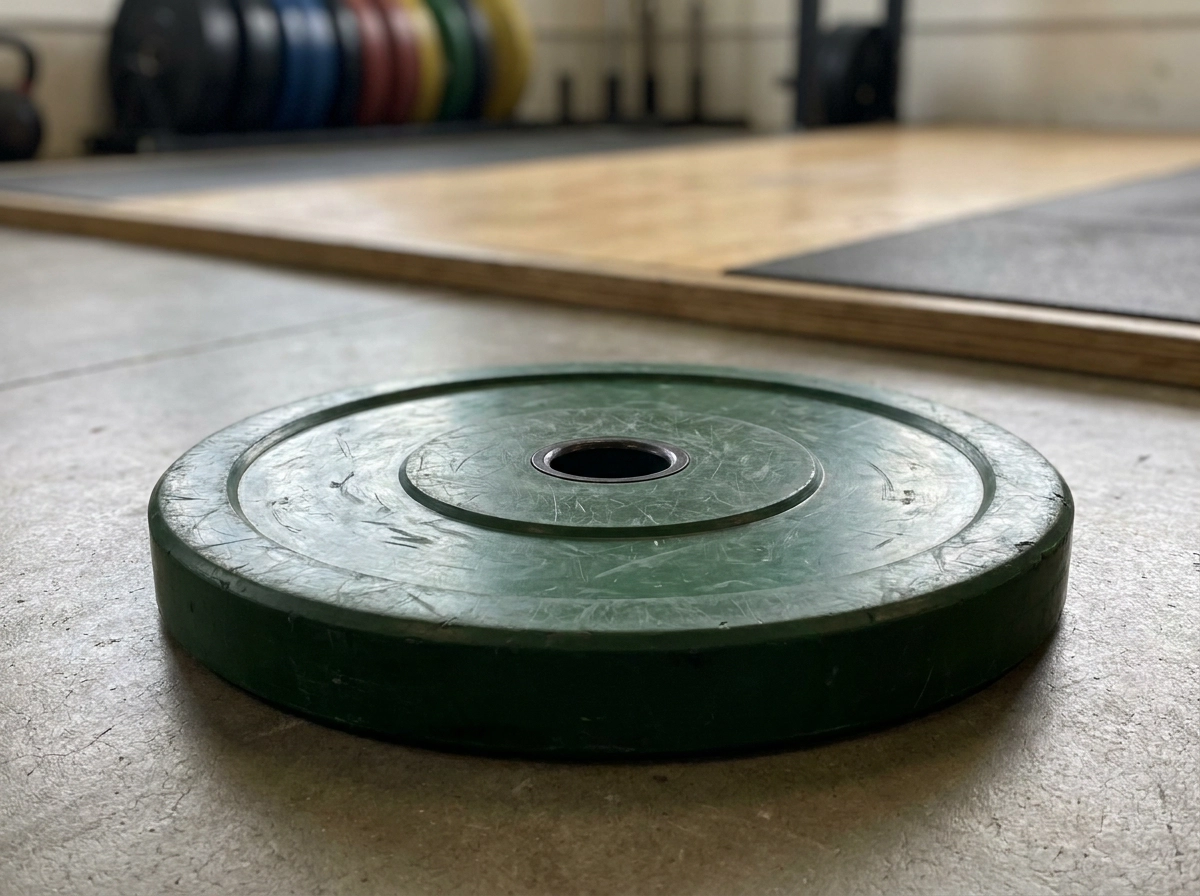
Standard Olympic rubber bumper plates are the right choice for most operators. Functional training boxes, CrossFit-style facilities, and general strength floors all perform well with standard rubber bumpers, provided the compound and hub spec meet commercial grade. These plates do not meet IWF calibration requirements, but for the vast majority of Australian gym operators, that distinction is irrelevant.
Competition-grade IWF-calibrated plates carry tighter weight tolerances and are colour-coded to IWF standards. They are required for any facility hosting sanctioned weightlifting competition, and worth considering where competitive athletes need to train on competition specification. The cost premium is significant; specify them only where the use case genuinely demands it.
Urethane bumper plates carry a higher upfront cost and are harder than standard rubber. Because urethane's hardness can place greater stress on flooring under long-term use, operators in high-drop environments should evaluate both the floor protection implications and the durability trade-off before specifying.
The following framework helps operators match plate type to facility reality:
Criteria | Standard Rubber | Competition IWF | Urethane |
|---|---|---|---|
Use case | Functional, general strength | Sanctioned competition | High-volume, 24/7 |
Durability | Moderate-high | High | Higher hardness; assess flooring compatibility |
Price tier | Lower | Premium | Mid-premium |
Best suited to | Boutique studios, boxes | Weightlifting clubs | Large membership gyms |
On ordering structure: bundled plate packs suit most new fit-outs, delivering a defined weight range across every platform at a predictable budget. Custom weight-range ordering makes more sense where platforms serve distinct programming streams and a standard bundle would leave certain denominations unused. Browse MasterKraft's commercial weightlifting equipment for available plate configurations before finalising your order structure.
Commercial vs. Home Gym Spec: Why the Difference Matters More Than the Price Tag
Plate type tells you what you're buying. Spec grade tells you whether it survives your facility.
Plates priced well below commercial grade may look attractive until they fail under daily commercial load long before a commercial-grade equivalent would. The price tag is the wrong comparison point; total cost of ownership is the right one.
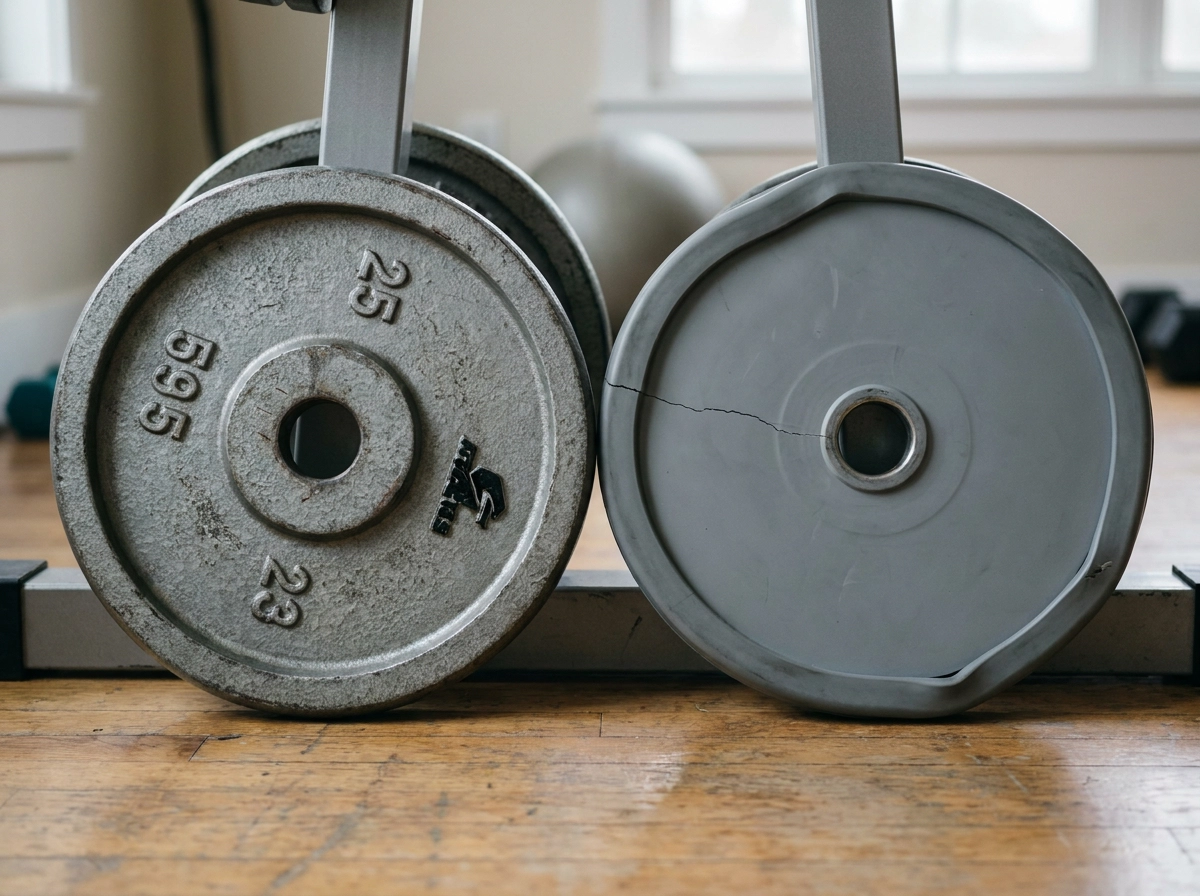
The failure modes that accelerate under commercial use are specific. Hub separation occurs when high-frequency drops fatigue the bond between the steel insert and rubber body, a process that plays out far faster on a busy strength floor than in a home gym. Rubber delamination follows a similar pattern, driven by cumulative impact cycles rather than any single event. Dimensional drift is less visible but operationally damaging: plates that creep outside their original tolerances create inconsistent bar loading across your platforms over time.
Member volume is the variable most operators underestimate. A plate rated for home gym use is not engineered for the session frequency of a busy commercial floor across multiple platforms. That is not a marginal difference in wear; it is a structural mismatch. For more on matching equipment grade to actual usage load, this guide to specifying commercial gym equipment in Australia works through the framework in full.
There is also a liability dimension that sits outside the equipment budget entirely. Specifying sub-commercial equipment in a commercial facility can create exposure with your insurer and complicate your obligations under Australian workplace health and safety requirements if equipment fails during member use.
To calculate a cost-per-drop benchmark: estimate your daily class or open-floor sessions, multiply by average drops per session, then divide your plate purchase cost by projected total drops over a three-year period. Compare that figure across product tiers rather than comparing sticker prices.
What to Ask Any Supplier Before You Place an Order
Once you've assessed the spec, the next question is whether the supplier can actually deliver, literally and operationally.
Get service commitments in writing. A verbal assurance is worthless when a delivery is short 200 kg of plates two days before a facility opens. Ask specifically: what is the documented response time if a product fails or an order arrives incomplete? A measurable SLA, such as a 72-hour resolution commitment, is different from goodwill. If a supplier cannot produce it in writing, treat that as a data point.
Confirm actual stock holdings and Australian lead times. Premium international brands entering the Australian market are not always holding local inventory. Lead times can vary significantly depending on origin, freight consolidation, and customs clearance. For a fit-out with a fixed opening date, that gap can be critical. Ask where stock is held, not where the supplier is based.
Clarify delivery scope before you sign. Drop-shipping a palletised order to a loading dock is not the same as on-site delivery with equipment positioned and ready for use. The distinction affects your opening timeline and your staff's workload. Ask whether installation is included, coordinated, or priced separately.
Ask how co-branding is priced. If bespoke sizing or branded plates are quoted as a customisation premium, that cost compounds across a multi-site rollout, so get the basis of the price in writing before you commit to a network spec.
Read pricing transparency as a signal. Suppliers who publish pricing openly are easier to budget around and tend to stand behind their specifications. A contact-form barrier often means the price shifts depending on how the conversation goes, which is a particular burden for independent operators comparing options without a procurement team.
For context on how supply chain complexity affects these questions, MasterKraft's guide to commercial gym fit-out in New Zealand illustrates how lead time and installation gaps compound when local support is thin.
Franchise and Multi-Site Considerations That Get Overlooked
At network scale, every procurement decision compounds, and not every supplier is structured to handle that.
Standardise the specification, not just the brand. When every site in your network runs the same bumper plate, members moving between locations lift on identical equipment. Staff know what to inspect, what to order, and what to replace without referring upward. Maintenance becomes a system rather than a site-by-site judgement call.
Structure procurement around site opening dates, not warehouse capacity. A well-structured agreement with your supplier stages delivery to each site as it approaches opening, rather than releasing full stock on contract execution. This keeps capital working in your business rather than sitting in a warehouse. Confirm in writing that your supplier can hold allocated stock against a rollout schedule without requiring full prepayment on delivery.
Negotiate co-branding into the network agreement rather than per order. Franchise operators who treat branded equipment as a per-site customisation add-on pay an uplift each time, which erodes the benefit of network buying power. Settle the basis of that price once, at the volume tier. If you are working through the full capital picture, the guide on what it actually costs to open a gym in Australia covers where branded equipment sits in a realistic fit-out budget.
Supplier track record at scale is an operational filter, not a marketing claim. MasterKraft has fitted out 229 sites across 12 countries, covering equipment, flooring and storage, which is the kind of history that shows whether documentation, logistics coordination and post-installation support are built for network complexity.
Write the specification into your franchise standard. Define the minimum plate grade, construction spec, and approved supplier in your operations manual. This prevents future site operators from substituting cheaper alternatives that degrade the member experience and expose the network to liability.
Transparent Pricing and What It Actually Signals About a Supplier
Contact-form gatekeeping costs independent operators time they do not have. When a gym owner budgeting a fit-out needs to compare plate specifications across three suppliers, a "request a quote" barrier on two of those sites adds days of lag to a decision that may already be under capital pressure. Transparent pricing on a product page removes that friction entirely.
Enterprise buyers can absorb this. An operations manager standardising equipment across 20 sites can schedule supplier calls and wait for formal quotes. An independent owner opening a single facility, often for the first time, cannot easily price a fit-out when much of the market keeps its numbers behind a form.
Pricing transparency is also a proxy signal worth reading carefully. A supplier confident in its product-to-price positioning tends to publish that positioning openly. A quote-only model is not automatically disqualifying, and there are legitimate reasons for it on large installed equipment, but operators should treat pricing visibility as one indicator of how a supplier positions itself and how quickly you can budget around it.
Aggressive promotional discounting is a separate signal. Deep sitewide sales on strength equipment are worth interrogating. Ask whether the discount reflects a clearance event, a change in stock, or simply how that supplier structures its list pricing.
For budgeting purposes: allow for a full standard weight range per platform, across the number of platforms your floor plan supports. Budget a contingency above per-plate cost to account for delivery, installation, and early replacement of the lightest plates, which manufacturers commonly warn should not be dropped on their own.
Making the Right Call for Your Facility
Once you've worked through pricing, the final decision comes down to honest operational assessment.
Specify for actual use, not aspirational programming. A 24/7 facility running strength and functional training across six platforms at peak hours needs a different plate spec than a boutique studio with two platforms and a structured class timetable. Match your specification to real member volume and session intensity. Buying down to save capital and buying up to future-proof both carry risk; the right answer sits in an honest read of your current floor.
Evaluate suppliers on documented service commitment, a written SLA, confirmed local stock, and on-site delivery, not on promotional copy.
For franchise operators, plate specification set at the network level is a brand and logistics decision that compounds across every site.
MasterKraft publishes a 72-hour service SLA, in writing, covering response and resolution, and puts prices on its product pages rather than behind an enquiry form, with larger machines quoted on enquiry.
Ready to move forward? Review the MasterKraft bumper plate range online, or request a facility equipment quote for a new fit-out or network rollout.
Conclusion
Getting specification and supplier selection right is an operational decision that determines how your floor performs over years of daily use. For franchise operators, the consequences of that decision compound across every site in the network.
Review the full range online today, or request a facility quote for your fit-out or network rollout. The right decision starts with the right conversation.