

· Steve Callanan · 5 min read
A cable machine is the most adaptable piece of strength equipment you can put in a room. With adjustable pulleys and a few attachments, one station covers pressing, pulling, rotation, single-arm work and the accessory exercises that free weights make awkward.
The choice is not whether to have cables, but which kind. A stand-alone functional trainer, a rack with pulleys built in and a larger functional training system all give you cable work, in very different footprints. This guide compares them, then covers the attachments that make any of them useful.
What a cable machine does well
Cables apply resistance in the direction the cable runs, not just straight down like a dumbbell. That opens up exercises that are hard to load any other way:
- Rotations and chops, where the load comes from the side.
- Face pulls, pulldowns and rows from high or low angles.
- Single-arm and single-leg work, with smooth, constant tension.
- Accessory work such as flyes, curls, pushdowns and kickbacks.
That versatility is why PTs tend to gravitate to cable stations. The machine adapts to the client instead of the other way round.
Option 1: the functional trainer
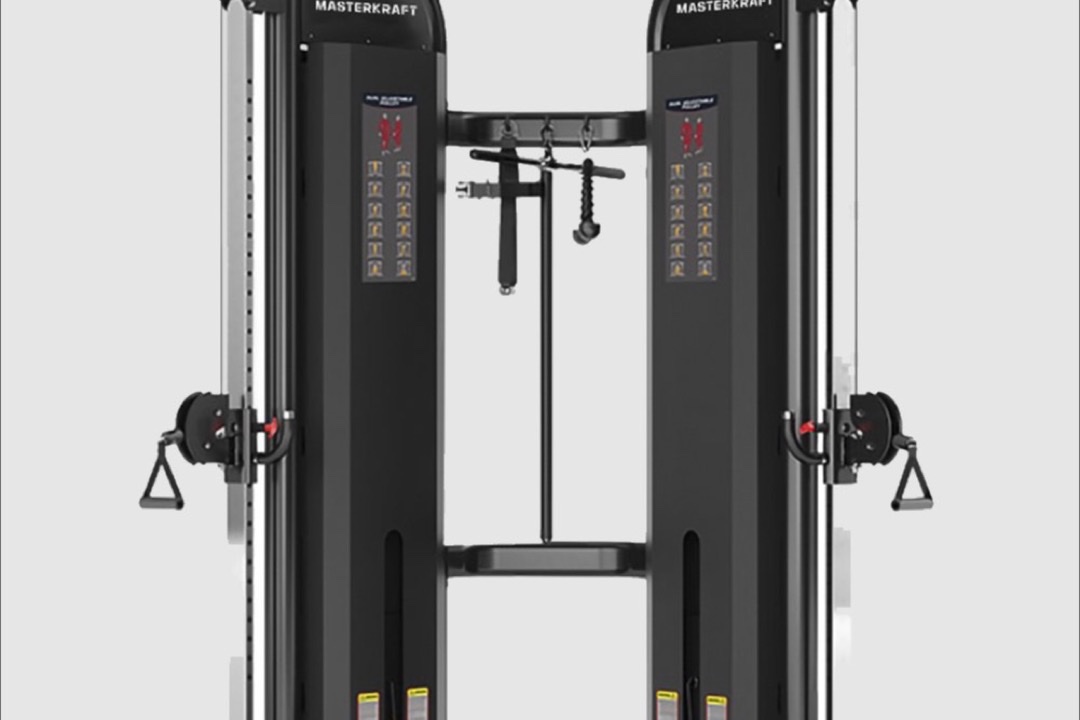
A functional trainer is a stand-alone frame with two adjustable cable columns, each running from the floor to overhead and each loaded by its own weight stack. Because the two sides are independent, you can work both arms together, one arm at a time, or one side against the other.
MasterKraft's Functional Trainer Pro offers multiple cable positions on an adjustable pulley system. Its published assembled size is 2,070 mm long, 1,220 mm wide and 2,300 mm high, and its net weight is 414 kg, which tells you two things: it needs a solid floor, and it needs a ceiling with clearance above 2.3 metres.
A functional trainer suits:
- Home gyms that already have free weights and want cable work in one footprint.
- PT studios, where one station has to serve many clients and many exercises.
- Commercial floors that want the broadest range of exercises from a single machine.
The trade-off is that a functional trainer is only a cable station. It does not give you a place to squat or bench with a barbell.
Option 2: a rack with dual pulleys
If you also want a barbell rack, a rack with pulleys built into the uprights does two jobs in one footprint. You squat and press on the rack, and use the cables from the same station.
MasterKraft makes two versions:
- The Olympic Half Rack with Dual Pulley, a half rack with dual pulleys built into the uprights.
- The Olympic Power Rack with Dual Pulley, a full four-post cage with dual pulleys integrated into the frame.
For a home gym or a small studio buying one major strength piece, a dual pulley rack is often the most efficient choice. The trade-off is that only one person can comfortably use it at a time, so barbell work and cable work compete for the same station. If you are still choosing the rack itself, our squat rack guide compares power racks, half racks and squat stands.
Option 3: a functional training system
A functional training system, often called a rig, is a modular steel structure that anchors a whole training zone. It is built for group sessions and small-group PT, with room for several people to work at once.
MasterKraft's Functional Training System runs from the Functional Training System 1.0, the entry configuration for PT studios and compact functional zones, up through larger configurations to 5.0. The range is built to scale, so a 1.0 can be a starting point rather than a ceiling. Mid-size configurations such as the 3.0 are often specified as the functional zone inside a larger commercial gym.
Check each configuration's product page for what it includes, and ask us how cable stations fit into the layout you have in mind. For a studio running classes, a rig is usually the backbone of the room, with cable stations sitting alongside it rather than replacing it.
Comparing the three
| Functional trainer | Dual pulley rack | Functional training system | |
|---|---|---|---|
| Main job | Cable training | Barbell plus cables | Zone for group and PT work |
| Users at once | One or two | One | Several |
| Best for | Home, PT studio, commercial floor | Home, small studio | Studios, PT gyms, commercial |
| Footprint | One station | One station | A zone |
Attachments worth having
A cable station is only as versatile as the handles you clip to it. A useful starting set:
- Single handles, for one-arm presses, rows and flyes.
- A straight or lat bar, for pulldowns and rows.
- A tricep rope, for pushdowns, face pulls and curls.
- A V-bar or row bar, for close-grip rows and pulldowns.
- Ankle straps, for glute kickbacks, leg lifts and other lower body work. The Ankle Strap Cable Attachment (Pair) attaches to any MasterKraft cable machine with a D-ring and an adjustable velcro strap.
Store attachments on hooks or a rack near the station, not on the floor. Lost handles are the most common reason a cable machine gets used for fewer exercises than it could be.
What to check before you buy
- Ceiling height and footprint, including room to step back from the station with a handle in each hand.
- Floor strength and flooring, given the machine's weight.
- Pulley adjustment: how many positions, and how quickly you can change them between sets.
- Warranty split between frame, pulleys, cables and wearing parts. Cables wear faster than steel, so read that line.
Choose the cable machine that fits the room
For a home gym or PT studio wanting the widest exercise range from one footprint, a functional trainer is the usual answer. If you need a barbell rack as well, a dual pulley rack does both jobs. For group training, a functional training system anchors the room.
Browse the full range of cable machines to compare options, or talk to our fit-out team about planning a studio or commercial floor around the right mix.