


· Steve Callanan · 17 min read
Most gym operators approach equipment procurement the wrong way. They search for a product, compare a few prices, and assume the market works like any other retail category. It does not, and that misunderstanding costs Australian gym businesses time, money, and operational reliability every year.
The Australian commercial gym equipment sector is more fragmented than most operators realise. The choices available to you are not equal, and neither are the risks attached to each one. What looks like a straightforward purchasing decision is actually a strategic one, shaped by supplier tiers, service gaps, and a structural false choice that traps independent operators.

Why "Gym Equipment" Is the Wrong Starting Question
Most operators begin their gym equipment search the same way: opening multiple supplier websites and comparing product catalogues. It feels like the logical starting point. It is not. The procurement decision is largely made before a single item is quoted, and it is made at the supplier level, not the product level.
The questions that actually determine facility ROI have nothing to do with frame dimensions or weight stack increments. They are: what happens when something fails, who installs the equipment and is accountable for the outcome, how long does delivery realistically take, and can you get a price without submitting a contact form and waiting for a discovery call? These are supplier operating model questions, and most operators never ask them until something goes wrong.
The structure of the Australian market compounds this problem. Suppliers range from global manufacturers to single-showroom retailers to refurbished-stock dealers, and their catalogue language is largely interchangeable. Navigating that purely on equipment specifications produces decisions that look sound on paper and underperform on the floor.
The fragmentation matters because it obscures structural differences between suppliers that are far more consequential than any product specification. A supplier's installation capability, written service commitments, and pricing accessibility tell you more about how a facility will operate in year two than any spec sheet reviewed in year zero.
Reframing the search around supplier capability, service commitments, and total cost of ownership does not mean ignoring product quality. It means applying the correct filter first, so that product evaluation happens within a shortlist of suppliers who can actually support a commercial facility rather than across every catalogue in the market.
How the Australian Market Breaks Into Three Tiers
Once you accept that supplier selection precedes product selection, the next question is structural: which kind of supplier are you actually dealing with?
The Australian commercial gym equipment market divides into three tiers, and each has a distinct logic that determines pricing, service model, and suitability for different facility types.
Tier 1: Enterprise-Grade Premium
Suppliers at this level, Life Fitness being the most prominent example, carry decades of operational history. Life Fitness was founded in 1977 and states that it operates in over 120 countries. Their engineering reflects the full breadth of that client base: hospital rehabilitation facilities, hotel fitness centres, and corporate wellness programmes sit alongside performance gyms in their design brief. The result is equipment built to institutional procurement standards, with pricing and support structures calibrated accordingly. For a 200-member independent gym, that institutional overhead is largely wasted capital.
Tier 2: Mass-Market Retail
Dynamo Fitness lists 14 stores across five states. Verve Fitness states over 16,000 commercial fitouts completed and over 3,000 verified customer reviews. Both compete on catalogue breadth, physical presence, and volume. Those are genuine assets, but neither catalogue breadth nor review volume tells you what happens when a machine fails, so ask each supplier directly for a written response and resolution commitment. Specialist manufacturers such as AlphaFit and Vulcan Fitness also sell into this space.
Tier 3: Budget and Refurbished
Operators like Grays Fitness specialise in used and refurbished commercial fitness equipment, serving facilities with constrained budgets or temporary setups. The constraint is remaining service life. Refurbished stock has already spent part of its working life elsewhere, and a high-utilisation facility cycling members through equipment daily will consume the rest of it faster than a low-traffic site will. Establish the age, service history and warranty position of every unit before procurement, not after. The real costs of opening a gym in Australia rarely account for accelerated replacement cycles from underspecified equipment.
Geography and the Fragmentation Opportunity
Across all three tiers, fragmentation remains high, which creates a real advantage for suppliers with national delivery and professional installation capability rather than showroom-dependent models. For operators outside major metro areas, the question of who physically installs the equipment is not academic. A review of completed gym fitouts across Australia illustrates what that national delivery and installation footprint looks like in practice.
The first filter any operator should apply is simple: identify which tier a supplier actually occupies, not which tier their marketing implies. The language used to describe product quality, value, and service varies far less between tiers than the actual delivery models do.
The False Choice Trapping Independent Operators
Knowing which tier a supplier occupies is the first filter. The harder problem is what happens once an independent operator or challenger franchise actually tries to buy.
The market structure creates a binary that looks like a choice but functions like a trap. Tier 1 engineering is built for institutional procurement: hospital rehabilitation facilities, hotel chains, and enterprise health clubs with capital budgets, procurement teams, and utilisation profiles that justify the price point. A 200-member independent gym in regional Queensland does not have those margins, and locking budget into that tier leaves less capital for flooring, lighting, functional zones, and the fit-out elements that actually move the needle on member acquisition. The cost of over-engineering is not abstract; it is the rig you could not afford, the lighting that stayed basic, the functional training zone that never got built.
The cost of going the other direction is equally concrete, just distributed differently across time. Flat-pack Tier 3 imports carry their real price in failure rates, not in the purchase invoice. A cable machine that fails under real member loads during a Monday evening peak is not a maintenance line item. It is a membership complaint logged that night, a class cancellation the following morning, and a facility reputation event that circulates on local social media before the repair quote arrives. Neither the safety exposure nor the damage to member trust appears in the original purchase comparison.
What makes this trap effective is that it is invisible at the point of purchase. Suppliers present these tiers as "quality" versus "value," which sounds like a reasonable spectrum. It obscures the structural reality: both ends of that spectrum carry costs for operators sitting outside the institutional procurement bracket.
This is the operating reality MasterKraft is built around. The catalogue sits at commercial-grade durability because the engineering is sized for real member utilisation, not institutional over-specification. The pricing is set for operators making capital decisions without procurement teams behind them.
The false choice dissolves when the third option is actually built, rather than just described.
What a Commercial-Grade Middle Market Actually Looks Like
So what does the middle actually deliver, in concrete terms?
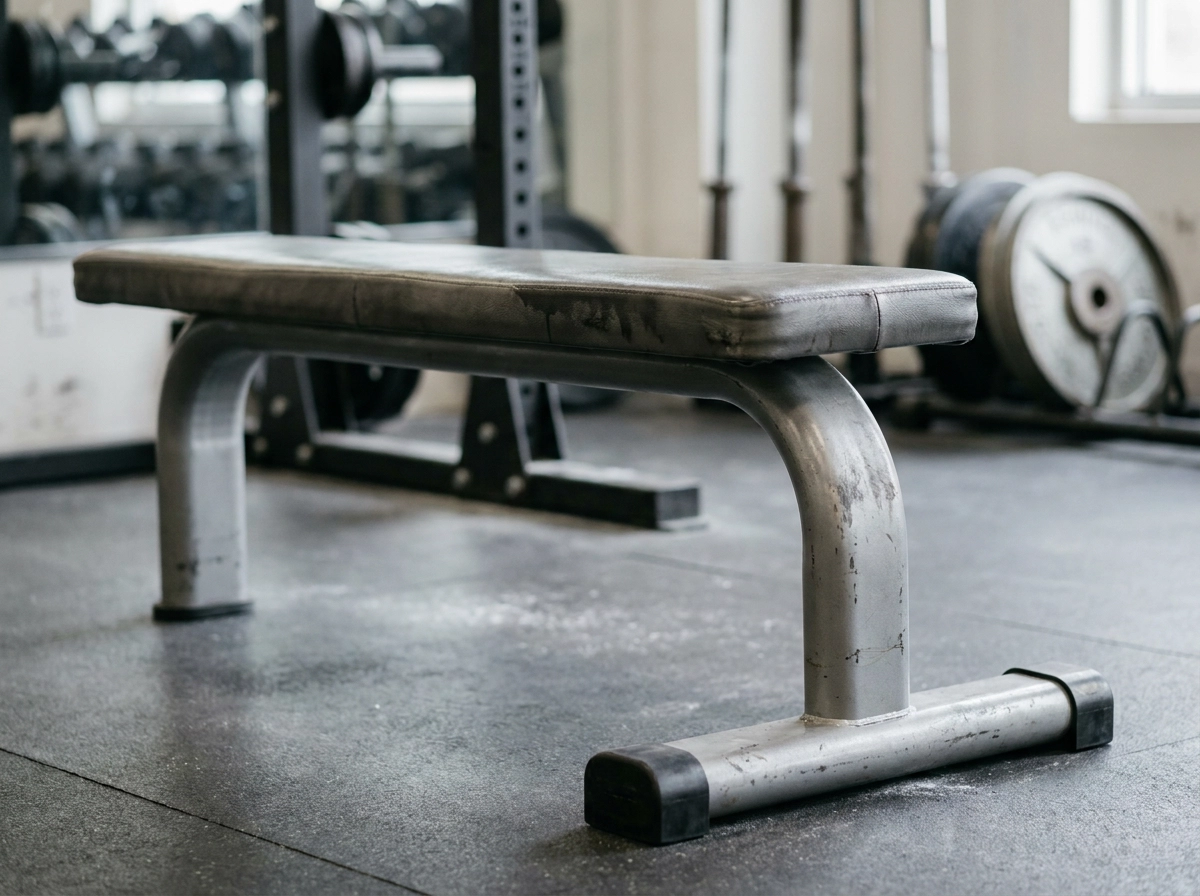
Commercial-grade in this context means equipment engineered for real utilisation loads, daily multi-user volume, chalk, sweat, dropped weights, peak-hour throughput, without the institutional over-engineering sized for hospital rehabilitation facilities or hotel chains. ISO 20957 is the relevant reference point: it classifies stationary training equipment by intended use, with class S covering professional and commercial application and class H covering home use. It sets no frame steel gauge, so treat a quoted gauge as a marketing number rather than a standards claim, and ask instead which ISO 20957 class the equipment is built and certified to.
TCO Is the Only Honest Metric
Purchase price is a poor unit of comparison when the real cost plays out over 36 months on the gym floor. A cable machine purchased at a lower price point that requires significant repair or replacement under commercial loads carries a higher total cost of ownership than one purchased at a higher initial price with a documented service commitment behind it. That replacement cycle is invisible in a purchase order and very visible on a P&L.
If you want to spec equipment to your actual usage load rather than to a price point, TCO is the framework that makes the comparison honest.
Bespoke and Transparent as Standard
Bespoke sizing and co-branding should be included in the base offering, not quoted as customisation premiums. Franchise operators and independents building a brand identity are not asking for something exceptional; they are asking for equipment that represents their facility correctly. Charging extra for that is a supplier model designed around large procurement teams who absorb negotiation friction, not around operators making direct capital decisions.
Prices published on product pages, with larger machines quoted on enquiry, remove most of the discovery overhead that weighs heaviest on solo operators.
That is not a feature list. It is a supplier model built around how independent operators actually make decisions with real capital on the line.
The Service Gap Nobody Is Talking About
Transparent pricing removes one procurement barrier. It does not remove the one that hits hardest after the purchase order is signed.
Post-sale support is often described only as a contact page or a phone number, with no stated response time attached. Whether a given supplier publishes a written service SLA is something to check directly on your own shortlist, because it is not something you can infer from the size of the catalogue or the review count.
The practical consequence matters more than the observation. "Contact us for support" is not a service commitment. It is a risk transfer. The supplier retains discretion over response speed, resolution scope, and escalation priority. The operator absorbs the operational exposure of that discretion during every hour a piece of revenue-critical equipment is out of service.
Why Post-Sale Service Determines Facility ROI
A facility that loses a cable stack or a row of treadmills for two weeks during a drawn-out resolution process does not recover that period cleanly. Members notice. Classes get cancelled or restructured. Complaints accumulate. Some members do not renew. None of that appears on a product specification sheet, but all of it is a direct consequence of the service model sitting behind the product. Pre-sale specifications describe equipment performance under normal conditions. Post-sale service determines facility performance under the conditions that actually stress the operator relationship.
MasterKraft publishes a 72-hour service SLA, in writing, covering response and resolution. A cable stack failing at 6pm on a Tuesday is not a scheduled maintenance event with a flexible timeline. It is a facility problem with member-facing consequences that begin accumulating immediately, and a stated 72-hour window tells an operator what to expect. Operators fitting out facilities across the Tasman face a sharper version of the same question, because supply chains are longer and local support is thinner.
Before signing any purchase order with an Australian gym equipment supplier, ask one question: what is your written service response and resolution commitment? The answer, or the absence of one, tells you more about how that supplier will behave when something goes wrong than any catalogue, review count, or founding year narrative they lead with.
Franchise Networks vs. Independent Operators: Same Standards, Different Scale
The service gap matters most when equipment is already down. But the preceding question, for any operator evaluating a supplier, is whether that supplier is structured to serve them at all, or whether their order size quietly determines the quality of process they receive.
What Franchise Networks Actually Require
Large franchise networks and multi-site operators, spanning 24/7 gym formats, boutique studios, health clubs, and pilates and functional training brands, face a supply problem that is fundamentally about replication. A fitout delivered to Site 1 must be reproducible at Site 14 without degradation in quality, timeline, or installation standard. That demands documented delivery and installation processes, not good intentions. Suppliers without that process infrastructure fail franchise networks not on product quality but on consistency, and inconsistency in a franchise model is a brand and compliance liability.
What the Market Actually Delivers to Independents
Independent operators opening or refurbishing a single facility need exactly the same things: commercial-grade equipment, professional installation with accountable people on site, and a service commitment that holds when something goes wrong. What the market typically delivers instead is proportionate attention. Lower order volume means slower response, less rigorous installation support, and in many cases higher effective pricing because independents cannot negotiate volume terms. The result is that the operator who most needs a reliable supplier is the one most likely to receive a pallet at the kerb and a phone number.
One Operating Model for Both
MasterKraft's deployment across 229 sites in 12 countries provides the documented scale evidence that franchise networks require before committing a supplier to a rollout programme. The operating model, however, is not tiered by order size. A single independent order runs through the same delivery, installation, and commissioning process as a national rollout. An independent gym owner in regional New South Wales receives professional on-site installation, not a flat-pack delivery. That is the standard franchise networks have always demanded; it is the standard independents rarely receive from the broader market.
Complete Scope, Not Equipment Only
Fitout scope matters here because partial suppliers create coordination risk. MasterKraft's fitout scope covers equipment, flooring and storage, across a catalogue organised into 12 categories. Both franchise networks and independent operators need a complete facility, not a catalogue selection dropped into a space someone else has to finish. Single-supplier scope closes the accountability gap that partial fitouts create.
Why the Operator Background of Your Supplier Matters
A supplier's catalogue tells you what they sell. Their operational background tells you whether they understand what you're buying it for, and that distinction matters far more than most operators realise until something goes wrong.
Across the Australian commercial gym equipment market, the dominant credibility signals are heritage metrics. Founding year, countries served, review volume. These are verifiable numbers, but they answer a different question than the one a facility operator is actually asking. Knowing that a brand has decades of history or has supplied facilities across multiple continents does not tell you what happens at 6pm on a Tuesday when a cable stack goes down during peak hour and you have members waiting.
The gap between those two questions is where operational experience becomes the actual differentiator.
A supplier who has managed a gym has stood in front of that problem. They have made the call about whether to pull the equipment from the floor, improvise a workaround, or absorb the member complaints while waiting on a resolution. They have also made the capital allocation decisions that their customers are currently facing: which zones to prioritise, how to sequence a fitout so the facility generates revenue before every piece of equipment arrives, why co-branding matters to a franchise operator building site consistency across a network. That accumulated knowledge changes the quality of advice at every point in the procurement process, in ways that a product specification sheet cannot reflect.
MasterKraft positions itself explicitly on this background, describing its team as real operators, people who have actually run training floors, and pointing to its written service commitment as the consequence of that.
The practical test is whether a supplier will put a number on it. MasterKraft publishes a 72-hour service SLA, in writing, covering response and resolution. A supplier who cannot state a response and resolution window at all is leaving the timing to its own discretion and the consequences to yours.
What to Demand From Any Australian Gym Equipment Supplier
Knowing what separates a capable supplier from a costly one matters more at the shortlist stage than after you have signed a purchase order. These six questions cut through catalogue marketing and surface how a supplier actually operates.
Can you get a price without submitting a contact form? Friction at the pricing stage signals friction at every stage that follows. Ask before you shortlist.
Is there a written service SLA, and is it published? Ask for the written response and resolution timeline. The presence or absence of a published SLA tells you more than any catalogue does.
Is installation performed by people on site? Kerb delivery shifts accountability entirely to you: fitout timelines slip, commissioning problems go unresolved, and insurance liability for incorrect installation sits with the operator. Professional installation means people on site who own the outcome, not a driver who hands over a pallet.
Are bespoke sizing and co-branding included or quoted separately? Franchise operators and independents building a brand identity should not carry a customisation premium for equipment that correctly represents their facility. Ask the question before you receive a quote, because the answer changes the real cost of the order.
Does the supplier cover the complete facility? Flooring, storage, functional zones, cardio, and strength from a single supplier eliminates the coordination gaps and accountability disputes that arise when multiple contractors share a fitout. If your supplier covers equipment but stops at the loading dock, you are managing the integration risk yourself.
What is the actual deployment record? A product catalogue labelled "commercial" is not a track record. Ask how many completed facilities the supplier can reference, across what formats (boutique studios, 24/7 gyms, franchise networks, health clubs), and at what geographic scale. Two hundred and twenty-nine sites across 12 countries represents a documented evidence base. A catalogue with a commercial label does not.
These are not aspirational standards. They are the minimum an operator should expect before committing capital to a supplier relationship, and they are questions the market currently leaves largely unanswered.
Choosing a Gym Equipment Supplier With Confidence
Three criteria cut through the noise most reliably: transparent pricing, a written service SLA, and complete fitout capability. If a supplier cannot show you a price without a discovery call, cannot document their response and resolution commitment, and cannot cover the full facility scope, they are transferring risk onto you at every one of those gaps.
MasterKraft is built for the middle of this market. Prices sit on product pages rather than behind a form, with larger machines quoted on enquiry. The 72-hour service SLA is published in writing and covers response and resolution. Fitout scope covers equipment, flooring and storage. Bespoke sizing and co-branding are included as standard, not priced as extras.
Whether you are a national franchise or an independent owner, MasterKraft applies the same delivery, installation, and commissioning process, the same standard the 229-site deployment history was built on.
Browse the MasterKraft catalogue, organised into 12 categories with prices on the product pages and larger machines quoted on enquiry, explore the fitout planning resources to scope your facility properly, and reach out when you are ready to move. The process is the same for every operator.
Conclusion
The Australian gym equipment market rewards operators who ask the right questions before signing anything. Understand the three tiers before you compare prices. Reject the false choice between consumer-grade affordability and enterprise-scale minimums. Demand written service commitments, not verbal reassurances. And choose a supplier whose operational background matches the environment your equipment will actually face.
The difference between a facility that retains members and one that quietly loses them often comes down to a single procurement decision made under time pressure.
MasterKraft was built for operators who want commercial-grade quality, transparent pricing, and genuine service accountability without the enterprise overhead. The catalogue is open. The SLA is documented. The fitout scope is complete.
Browse the product range today, scope your facility using the planning resources, and build your gym on a foundation that holds up under real commercial use.