

· Steve Callanan · 20 min read
Most gym operators underestimate what a commercial gym fit out actually involves until the budget is already stretched and the opening date is close. By that point the major equipment is ordered, the floor plan is locked, and the costs that were never scoped start arriving anyway.
This guide is built for operators who want to avoid that position. Whether you are fitting out a single site, scaling a franchise network, or rethinking a floor plan that no longer reflects how members train, the decisions you make during fit-out will shape how your facility operates for years.
What a Commercial Gym Fit Out Actually Covers
A commercial gym fit out covers the full physical environment of a training facility: strength equipment, cardio machines, functional implements, rigs and racks, accessory storage, rubber flooring, ambient and task lighting, signage, and professional installation. Equipment supply is one input into that scope, not a synonym for it. Operators who treat the two terms as interchangeable tend to discover unbudgeted line items late, once contractors are on site and the launch date is locked.
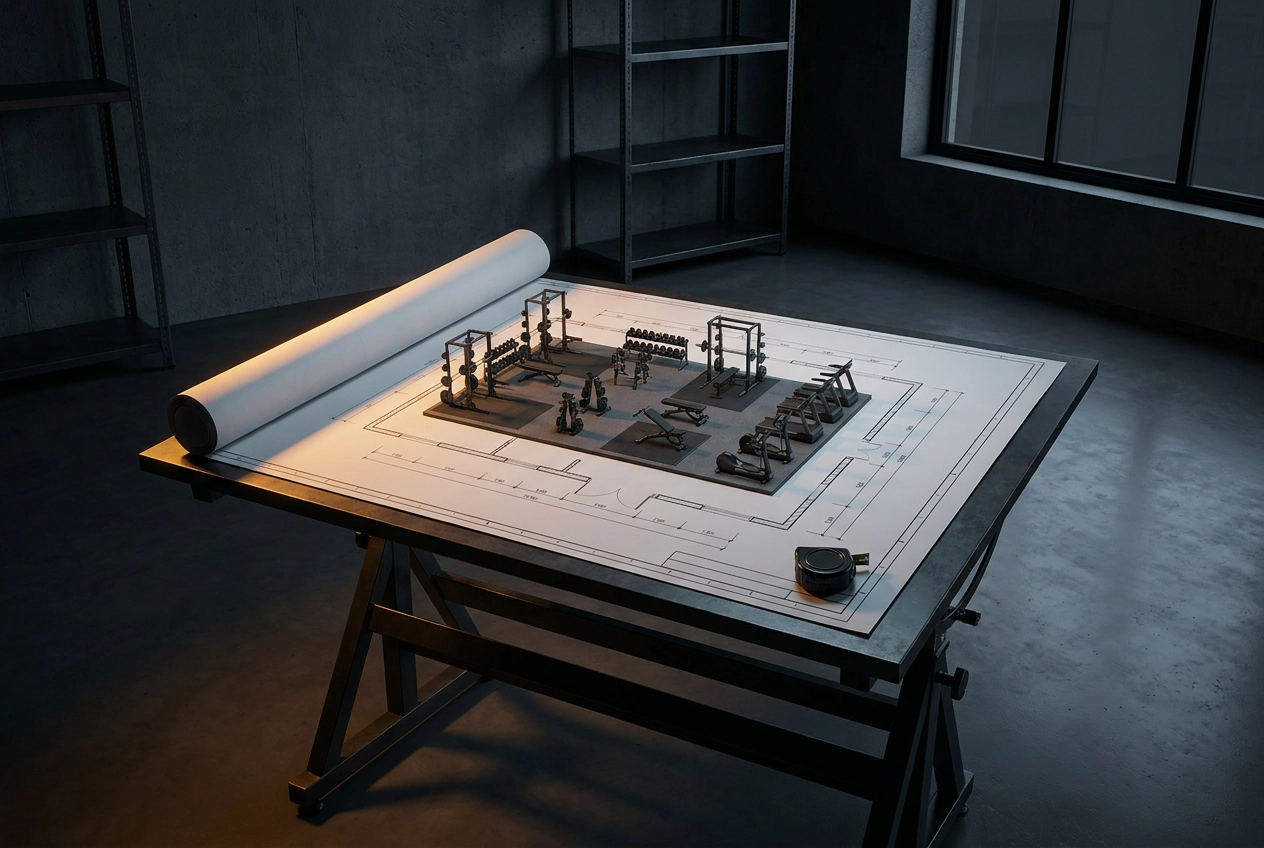
A complete fit out falls into six categories: strength and free weights, cardio, functional training, rigs and racks, storage, and flooring and lighting. Each carries its own specification decisions and must be coordinated with the others before a brief is finalised. Flooring zone thickness affects equipment placement. Rig installation requires ceiling clearance confirmed before steel is ordered. Lighting sign-off can gate council approval.
Two distinct buyer types navigate this scope from very different starting points. Franchisees enter with a network specification set for major equipment, but frequently inherit gaps in accessories, installation logistics, and servicing. Independent operators begin with a blank floor plan and must scope every category themselves.
The tension both groups share is the same: what they expect to be organised for them, and what actually lands on their desk unresolved. Understanding how the four phases of scope, spec, supply and support must run in sequence is where that resolution starts.
The Scope Most Operators Underestimate
That gap between "equipment list" and "full scope" is where most fit-out budgets break down, and it almost always traces back to the same omissions.
Accessories are the first casualty of an undercooked scope. A strength floor demands platform matting, collar sets, belt hooks, band pegs, and a cable attachment library before a single member can train effectively. None of these appear in standard rack or machine pricing. Each of these carries its own budget line and its own lead time.
Installation logistics are the second blind spot. Delivery to the loading dock is not commissioning. Someone needs to coordinate sequencing (flooring before heavy equipment, always), manage assembly, and hold liability when a piece arrives damaged. Without a named party responsible for each function, the operator absorbs the risk by default, creating real exposure under Australian workplace health and safety obligations.
Flooring is not a single specification decision. Rubber thickness, tile versus roll, and drop-zone reinforcement vary by zone, so a single specification across the whole facility is almost always wrong.
Lighting cannot be deferred without cost. Ambient and task lighting pushed down the priority list create contractor availability and timeline pressure that eliminate any room to negotiate cost once council sign-off or a pre-opening deadline forces the issue.
What Franchise Packages Typically Leave Out
Most franchise equipment packages are structured around visible, brand-defining assets: racks, cardio machines, benches, and major strength units specified to network standard. These items arrive ticked off on a handover checklist. What that checklist rarely includes is the operational layer beneath them: accessories, consumables, replacement stock, installation logistics beyond the delivery point, and ongoing servicing contracts. Those categories land with the franchisee, often without explicit acknowledgement in the disclosure documents.
The phrase "all equipment included" is the most reliable source of franchisee budget grief. In franchise disclosure documents, "equipment" typically means major capital items. Accessories, cable attachments, collars, and chalk holders are consumables in the franchisor's categorisation, not equipment. Auditing the agreement before signing means reading every inclusion list against a complete fit-out category checklist, then treating anything absent as a franchisee cost.
The timing compounds the problem. These costs sit outside the inclusion lists, so they tend to become visible only once contractors are on site and the launch date is committed, which is the point at which budget flexibility is smallest.
This pattern is not limited to entry-level franchise systems. Well-resourced networks with mature brand standards still leave operational category decisions to individual site operators. The franchisor standardises the member-facing equipment; the franchisee funds everything else.
The Hidden Costs That Surface Late in the Build
Those gaps do not appear late because operators failed to plan. They appear because the way fit-out packages are structured makes certain cost categories invisible until the project is nearly complete.
By the time contractors are on site, your lease obligations are active, and your marketing has committed to a launch date, budget flexibility is effectively zero. Discovering an unbudgeted cost at that point does not create a decision; it creates a pressure-forced spend at whatever price is available.
This is a procurement structure problem, not an operator error. Three cost categories surface most reliably at this stage: accessories and consumables on a strength floor, installation logistics and commissioning, and ongoing servicing.
Accessories and Consumables on a Strength Floor
Cable attachment libraries deserve specific attention. A full set of commercial-grade attachments (ropes, bars, handles, straps) is high-cost and high-usage, yet almost universally underspecified at fit-out stage. Operators often discover the gap when members start queuing for a single handle. Beyond cable attachments, collars, safety pins, J-hooks, band pegs, and weight plate storage all arrive as separate purchase decisions that standard rack pricing never covers. Multiply those line items across a full rack floor and the accessory bill is substantial before a single consumable enters the picture.
Consumables compound the problem. Chalk, resistance bands, and lifting wraps are almost universally purchased reactively in the first 90 days post-opening. Budgeted as a launch cost, they are manageable. Absorbed as unplanned spend against an already stretched operating account, they create a recurring cash drain at exactly the wrong moment.
The fix is straightforward: build a per-station accessory budget as a named line item in your fit-out spreadsheet, and price out a fully specified station before the quote arrives.
Installation Logistics and Commissioning Costs
Accessories represent one budget gap; installation represents another, and the two are frequently confused.
A supplier dropping pallets at your loading dock has fulfilled a delivery contract, not a fit-out commitment. Professional installation means a trained team commissioning every piece of equipment to manufacturer specification: torque settings verified, safety catches tested, uprights plumb, cables tensioned correctly. These are distinct services with distinct costs.
Installation cost categories include labour, access equipment (scissor lifts are standard for tall rig installations), sequencing coordination (flooring must be laid and cured before heavy equipment is positioned), and documented post-installation safety checks.
Suppliers who ship flat-pack or semi-assembled commercial equipment transfer every one of those costs, and the associated risk, to you or your contractors. Australian work health and safety regulations place a duty on the person with management or control of plant at a workplace to control the risks arising from its installation or commissioning. Where assembly is left to the operator, that duty sits with the operator.
Professional installation carries a visible cost. Self-managed logistics carry a hidden one, paid in delays, errors, rework, and compliance risk. The visible cost is almost always smaller.
Ongoing Servicing as an Operating Line Item
Predictive maintenance scheduling is where a structured servicing relationship earns its cost. Cable replacements, upholstery wear, console calibration, and lubrication schedules all follow usage patterns that can be modelled from member traffic data. Budget for them as a named line item from day one, and ensure your supplier can commit to scheduled preventive visits, not just reactive call-outs.
MasterKraft publishes a 72-hour service SLA, in writing, covering response and resolution.
When evaluating any supplier, ask directly: "What is your documented response time if a piece of equipment fails?" A supplier who cannot provide a written answer is transferring operational risk to you. Treat the absence of that answer as a procurement risk, not a minor gap to revisit later.
Planning a Strength-Dominant Floor Plan
Servicing strategy is one dimension of a fit-out. How the floor itself is zoned is another, and it changes the brief substantially.
If strength, free weights, and functional training sit at the centre of the floor rather than a cardio row, the planning work is different in kind, not just in quantity. Dedicated zones for core training and bodyweight work carry spatial, flooring, and storage requirements that a cardio-dominant layout never raises.
This is not simply an equipment procurement question. The floor planning brief, the zoning logic, the flooring specification, and the storage design all change with it, and those decisions need to be resolved before a fit-out partner is engaged, not after.
Why Strength Floors Are Denser, and More Expensive, Than Cardio Areas
The cost differential between the two is not abstract. A cardio row is relatively self-contained: each unit plugs in, occupies a defined footprint, and requires minimal ancillary infrastructure. A strength zone multiplies that complexity at every station. Racks, platforms, weight plate storage, collar sets, band pegs, cable attachment libraries, and drop-zone flooring all stack up before a single rep is performed. Operators applying cardio benchmarks to a strength zone consistently underestimate the per-square-metre cost.
Flooring specification drives a meaningful share of that gap. Cardio areas can run on standard commercial rubber tile at lighter gauge specifications. Olympic lifting and powerlifting zones require reinforced drop-zone construction, reinforced platform matting, and careful joint treatment at slab transitions to prevent movement under repeated load. Getting that performance requires specifying the right product for the right zone, not a single flooring grade across the full floor plate.
Equipment density also creates infrastructure demand that cardio areas do not. Cable machines, functional trainers, and multi-station rigs require more circuit capacity and more considered cable routing than treadmill rows. This has to be coordinated with your electrical contractor at the design stage, not during installation.
Staffing adds a further planning dimension. Strength floors require clearer sight lines and more deliberate staff station positioning to maintain adequate supervision during peak periods, which must be built into the layout brief from the outset.
Planning for Functional Space, Storage and Specialised Flooring
Functional training zones concentrate variety rather than mass: kettlebells, medicine balls, plyo boxes, sleds, resistance bands, and battle ropes across an open floor anchored by a rig system at one end.
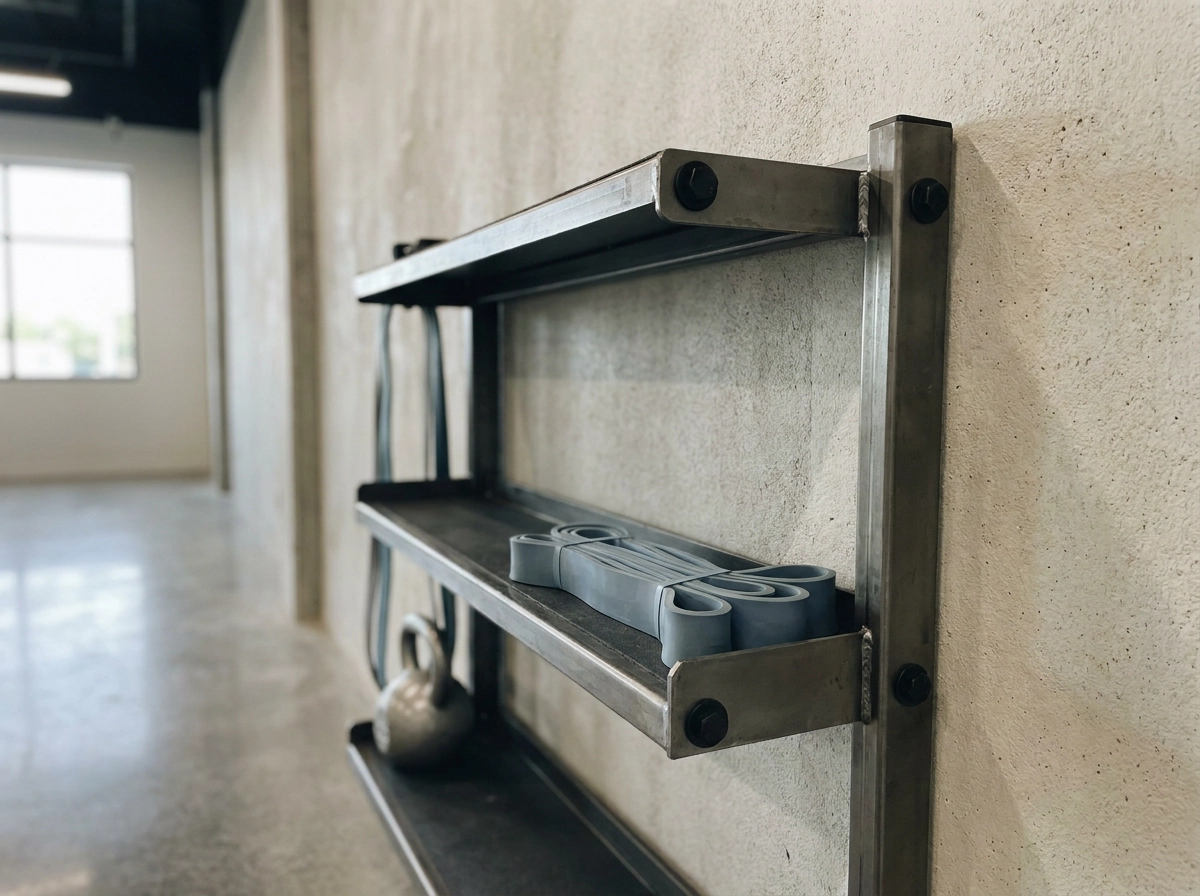
Storage is the most consistently underplanned element in these zones. The equipment-to-square-metre ratio is high, and without purpose-built storage specified from the outset, implements migrate across the floor, creating safety hazards and persistent disorder. Wall-mounted storage trees, horizontal rack systems, and dedicated sled parking need to appear in the design brief, not in a post-opening panic buy.
Rig specification requires early resolution. Wall-mounted rigs demand structural wall assessment and engineer sign-off; freestanding rigs require adequate floor footprint and ceiling clearance, confirmed during the site survey, for standard pull-up and rope attachment use. Span width and attachment point count must be locked before the fit-out brief is finalised, because both affect structural requirements and spatial zoning.
Flooring adds another coordination dependency. Turf sections, platform matting, and rubber roll in varying thicknesses each serve distinct zones and must align with the equipment layout, not be specified separately from it. When flooring and equipment are sourced from separate suppliers without a shared plan, junction points and thickness transitions routinely require rework. Specifying both through a single partner means zoning decisions are resolved once and applied consistently across the floor. MasterKraft states its fit-out scope as equipment, flooring and storage, which puts those decisions with one supplier.
Choosing a Fit-Out Partner: What the Australian Market Looks Like

Coordinating flooring, rigs, and equipment through a single partner solves the internal complexity. Choosing that partner is where the external complexity begins.
The Australian market is fragmented. No single supplier holds dominant authority across it, and a buyer comparing options is working through a long list of providers with very different capability.
More options do not simplify the decision; they increase evaluation load. The supplier range spans full-service fit-out partners who handle equipment, flooring, installation, and servicing under one agreement, through to pure importers who deliver pallets and consider the job done. The capability gap between those two ends is significant, and it is not always visible at the quote stage.
Three dimensions reliably separate capable partners from risky ones: supplier capability and scope, pricing transparency, and servicing commitments.
What to Actually Evaluate in a Supplier
Start with capability, not price. Before comparing quotes, determine whether each supplier can actually deliver the full scope: equipment, flooring, storage, installation, and post-opening servicing. A supplier who covers only part of that scope isn't cheaper; they're incomplete, and the gaps become your project management problem.
Evaluate suppliers across five dimensions: product range breadth, manufacturing or sourcing transparency, installation capability, servicing infrastructure, and proven site count in comparable facilities. A strong answer on price with a weak answer on servicing is not a strong answer overall.
Apply the site reference test before committing. Ask any prospective supplier for three comparable sites, matched on format, approximate size, and operator type, fitted out within the past 24 months. Then contact those operators directly. How the supplier responds to that request tells you as much as the references themselves.
Low-cost importers warrant specific caution. They can appear competitive at the quote stage, but they routinely transfer risk to the operator through flat-pack assembly requirements, limited spare parts availability, and no local servicing infrastructure. That risk isn't priced into the quote.
Site count is a meaningful proof point. MasterKraft lists 229 sites fitted out across 12 countries.
Transparent Pricing vs. the Contact-Form Quote Game
Once you have verified a supplier's capability and site references, the next evaluation point is pricing transparency, and the gap between suppliers here is significant.
Where a supplier runs contact-form-first pricing, requiring an enquiry submission before any figures are shared, that creates three compounding problems: it adds days or weeks to your comparison timeline, it hands the supplier information about your project budget before you have any reference point, and it opens the door to quote calibration based on perceived spend capacity rather than fixed commercial pricing.
Without published reference pricing, operators cannot independently sanity-check a quote, benchmark across suppliers, or build an internal business case before committing to a formal sales conversation. That information asymmetry consistently favours the supplier.
Transparent catalogue pricing signals something different. A supplier willing to publish pricing is demonstrating confidence in its value proposition. It is also reducing your evaluation cost, not increasing it.
MasterKraft puts prices on its product pages rather than behind an enquiry form, with larger machines quoted on enquiry. That lets operators scope much of a fit-out budget and stress-test financial assumptions before a single conversation takes place.
Treat contact-form-only pricing as a process risk in your evaluation. If a supplier withholds indicative pricing until a sales call, factor in the time cost of that evaluation cycle and the realistic probability of late-stage price surprises once the supplier has assessed your budget.
Servicing SLAs and What Equipment Downtime Costs You
Pricing transparency matters, but it is only half the evaluation. A supplier who publishes honest pricing and then provides informal, slow servicing support will cost you far more after opening day than the equipment itself.
Equipment that is out of service is equipment members cannot use, and the cost of that never appears on a maintenance invoice.
A documented servicing SLA changes this calculus. A meaningful SLA specifies the maximum time from fault report to technician attendance, a maximum resolution time, parts availability commitments for common wear items, and a defined escalation path for repeat faults on the same equipment. An informal arrangement, where you email a contact and wait, is operationally unacceptable for a 24/7 facility. The gym does not close; servicing support cannot effectively do so either.
Geography constrains servicing capability in ways suppliers rarely volunteer. A supplier based in Sydney may genuinely commit to a 72-hour response window for metro New South Wales sites and be structurally unable to honour that same commitment for a site in regional Queensland or Western Australia. MasterKraft publishes a 72-hour service SLA, in writing, covering response and resolution; ask any supplier for the written equivalent.
Before signing a supply agreement, request the supplier's servicing coverage map alongside their SLA documentation. Confirm your specific postcode falls within the committed response zone, not the general service area.
Multi-Site vs. Single-Site Fit Outs: Different Problems, Same Standards
Servicing capability is one dimension of supplier quality. Operator type is another, and it shapes everything from how a brief is written to how a fit-out is scoped and priced.
Whether an operator is opening a single site or rolling out across a network, the standard that members expect on the floor is identical. The problems getting there are not.
For multi-site operators, the core tension is consistency under variation. Every new location arrives with a different footprint, ceiling height, structural configuration, and local membership profile. Maintaining brand and equipment integrity across those variables, without rebuilding the specification from scratch each time, is a genuine operational and procurement challenge.
For independent operators, the tension is different: accessing commercial-grade quality without the capital overhead that premium brands assume.
Standardisation for Franchise Networks and Multi-Site Operators
For franchise networks, standardisation means four things delivered consistently across every site: a defined equipment specification, brand-compliant co-branding on equipment and storage, modular floor plans that scale across varying footprints, and a single supplier relationship that executes to the same standard whether the site is in Brisbane or Bunbury.
Supplier fragmentation is the quiet risk that compounds with growth. When each new location sources equipment from a different brand, the servicing complexity multiplies. Parts libraries diverge, technician familiarity becomes site-specific, and what should be a centralised servicing relationship becomes a patchwork of ad hoc arrangements across the network.
Co-branding is not optional for franchise operators; it is a brand compliance requirement. Colour-matched upholstery, logo applications on racks and storage, and consistent finish specifications across every site are standard network expectations. They should be delivered as part of the supply relationship, not invoiced as a customisation premium. MasterKraft states that equipment and branding can be customised, its own or the operator's; confirm in writing how that is priced at your order size.
Multi-site operators should negotiate a master supply agreement before the second site goes to brief. That agreement should lock in consistent pricing, priority scheduling for new site rollouts, and a single account management contact rather than site-by-site procurement that resets the relationship each time.
Getting Commercial-Grade Results Without Premium Overhead
The standardisation challenge is specific to networks. For independent operators, the problem looks different: the market presents a false choice between over-engineered premium brands that exceed what a single site can justify, and cheap imports that fail under real member use. Both outcomes cost more than a correctly specified fit out from the start.
Commercial-grade is not a label; it is a specification. Equipment built for commercial use is engineered and tested for multi-shift daily use across a wide range of body weights and training styles. Home-use equipment carrying a commercial label is not in the same category, regardless of price point.
When evaluating suppliers, look for four markers of genuine commercial-grade quality:
Load ratings that materially exceed the realistic upper range of member use
Frame and weld quality consistent with high-cycle fatigue loading, not light fabrication
Upholstery specification rated for commercial cleaning frequency and contact volume
Parts and servicing infrastructure that operates beyond the warranty period, not one that disappears after 12 months
Independent operators can access the same equipment specification as large franchise networks. The prerequisite is choosing a supplier who applies consistent standards regardless of order size. Ask directly how a supplier resources a single-site order while a network rollout is running at the same time, and get the answer before you sign.
How to Brief a Fit-Out Partner (And What to Ask)
Once you have the right supplier, give them the right brief. A fit-out partner cannot scope accurately without five inputs: a floor plan with dimensions and ceiling heights, your equipment category priorities, a realistic budget range, your opening timeline, and any franchise or network specification the site must meet.
Before committing, ask every prospective partner these questions directly:
What comparable sites have you completed in the past 24 months?
What is your documented response time for equipment faults post-opening?
Is your pricing published, and what does a scope variation cost?
Can you deliver bespoke sizing and co-branding without a premium surcharge?
Who specifically is on site during installation and commissioning?
Weak or vague answers to any of these are procurement risk, not negotiating posture.
Timeline sequencing deserves its own line in the brief. Flooring must precede heavy equipment placement; electrical and structural work must be resolved before rig installation. A supplier who cannot advise on this sequence is transferring a project management problem to you.
On budget: share it. Operators who withhold figures hoping for a lower quote consistently receive scopes that miss the mark. A fit-out partner with integrity designs to your budget rather than selling to it.
Finally, request a scope document, not just a quote. It should itemise every category, confirm who owns installation and commissioning, and document the post-handover servicing SLA in writing.
The Fit-Out Decisions That Determine How Your Gym Operates for Years
Once your brief is documented and your scope is agreed, the real question is whether the decisions behind that document were made with full information.
A commercial gym fit out is a series of interdependent decisions about space, equipment, flooring, storage, and servicing that will shape the operational quality and member experience of your facility for the next five to ten years. Getting the brief right matters because those decisions compound.
Three takeaways are worth carrying forward. Audit your franchise package or project scope before finalising your budget, not once contractors are on site and the flexibility is gone. Build accessory and servicing costs into your initial fit-out budget as named line items, not provisional figures. Evaluate fit-out partners on their servicing SLAs and comparable site references, not equipment pricing alone.
A strength-dominant floor plan raises flooring specification requirements, increases accessory density per station, and lifts per-square-metre cost compared with a cardio-heavy layout. Share your floor plan and opening timeline with your fit-out partner before budgets are locked, and hold them to a written scope that covers every category from flooring to servicing.
Conclusion
The decisions that matter most come down to four priorities: audit your full scope before budgets are locked; treat accessories and servicing as named line items from the start; evaluate partners on SLAs and site references, not equipment pricing alone; and plan your floor layout around how your members will actually train rather than around a cardio-first template.
Operators who treat the fit-out process as a series of informed, interdependent decisions consistently achieve better outcomes than those who treat it as a procurement checklist.
MasterKraft puts prices on its product pages, publishes a 72-hour service SLA in writing covering response and resolution, and lists 229 sites fitted out across 12 countries. Operators can share a floor plan and timeline to get a full scope and quote.